A teacher's analysis of the CBSE Class 10 Maths Standard (041) and Basic (241) sample papers for 2026-27: the unchanged paper pattern, chapter-wise marks for each paper, how the two papers overlap, and a practical preparation plan for Board Exam 2027.
Feel The Real Exam Before The Real Exam
Share your name and number and we will WhatsApp you the details of the Class 10 Topic-Wise and Full Mock Test Series.
Quick Facts
| Papers analysed | CBSE Class X Mathematics Standard (041) and Basic (241) Sample Question Papers 2026-27, with marking schemes |
|---|---|
| Pattern | 80 marks, 3 hours, 38 questions in Sections A to E; no change for 2026-27 |
| Biggest unit | Algebra, 20 of 80 marks in both papers |
| Calculator | Not allowed |
| Source | cbseacademic.nic.in (official CBSE) |
| Enquire about the test series | WhatsApp 7709585248 or support@edufestacademy.in |
The Short Version
If you only have a minute: the Class 10 Maths paper for the 2026-27 session looks the same as before. Both the Standard (code 041) and Basic (code 241) sample papers have 38 questions for 80 marks in 3 hours, divided into five sections. CBSE prints the line "There is no change in the Question Paper Design and Assessment Pattern for Academic Session 2026-27" on the pages of both papers.
What this means for you: you do not need to learn a new format. You need to be fast and accurate with the old one. The rest of this article shows where the 80 marks sit chapter by chapter, which questions repeat across the two papers, and how to spend your preparation time.
The Paper Pattern (Same For Standard And Basic)
Both papers use the same five sections. Calculators are not allowed, and π = 227 is to be used wherever the paper does not say otherwise.
| Section | Questions | Type | Marks each | Total marks | Internal choice |
|---|---|---|---|---|---|
| A | 1 to 18 | Multiple choice | 1 | 18 | None |
| A | 19 and 20 | Assertion and Reason | 1 | 2 | None |
| B | 21 to 25 | Very short answer | 2 | 10 | 2 questions |
| C | 26 to 31 | Short answer | 3 | 18 | 2 questions |
| D | 32 to 35 | Long answer | 5 | 20 | 2 questions |
| E | 36 to 38 | Case study (parts of 1, 1 and 2 marks) | 4 | 12 | In the 2-mark part of each case study |
| Total | 38 | 80 | No overall choice |
Chapter-Wise Marks: Mathematics Standard (041)
We tagged each of the 38 questions to a chapter and added up the marks. The chapters are listed from the most marks to the least.
| Chapter | Questions | Marks | Share of paper |
|---|---|---|---|
| Triangles | Q6, Q22, Q33 | 8 | 10.0% |
| Circles | Q29, Q37 | 7 | 8.8% |
| Real Numbers | Q1, Q21, Q26 | 6 | 7.5% |
| Quadratic Equations | Q4, Q32 | 6 | 7.5% |
| Coordinate Geometry | Q7, Q14, Q19, Q30 | 6 | 7.5% |
| Introduction to Trigonometry | Q8, Q23, Q31 | 6 | 7.5% |
| Some Applications of Trigonometry | Q17, Q35 | 6 | 7.5% |
| Surface Areas and Volumes | Q11, Q34 | 6 | 7.5% |
| Statistics | Q12, Q16, Q38 | 6 | 7.5% |
| Polynomials | Q2, Q20, Q27 | 5 | 6.2% |
| Pair of Linear Equations in Two Variables | Q3, Q36 | 5 | 6.2% |
| Probability | Q9, Q13, Q18, Q25 | 5 | 6.2% |
| Arithmetic Progressions | Q5, Q28 | 4 | 5.0% |
| Areas Related to Circles | Q10, Q15, Q24 | 4 | 5.0% |
| Total | 38 questions | 80 | 100% |
Chapter-Wise Marks: Mathematics Basic (241)
The same exercise for the Basic paper.
| Chapter | Questions | Marks | Share of paper |
|---|---|---|---|
| Triangles | Q15, Q16, Q20, Q32 | 8 | 10.0% |
| Circles | Q11, Q17, Q24, Q27 | 7 | 8.8% |
| Real Numbers | Q1, Q21, Q26 | 6 | 7.5% |
| Quadratic Equations | Q5, Q33 | 6 | 7.5% |
| Arithmetic Progressions | Q6, Q7, Q37 | 6 | 7.5% |
| Coordinate Geometry | Q8, Q25, Q28 | 6 | 7.5% |
| Introduction to Trigonometry | Q14, Q22, Q29 | 6 | 7.5% |
| Some Applications of Trigonometry | Q13, Q35 | 6 | 7.5% |
| Surface Areas and Volumes | Q18, Q34 | 6 | 7.5% |
| Probability | Q9, Q19, Q38 | 6 | 7.5% |
| Pair of Linear Equations in Two Variables | Q3, Q4, Q31 | 5 | 6.2% |
| Statistics | Q10, Q12, Q30 | 5 | 6.2% |
| Areas Related to Circles | Q36 | 4 | 5.0% |
| Polynomials | Q2, Q23 | 3 | 3.8% |
| Total | 38 questions | 80 | 100% |
Standard And Basic Side By Side
Put the two papers next to each other and the chapter totals are close. Only a few chapters differ.
| Chapter | Standard marks | Basic marks | Difference |
|---|---|---|---|
| Real Numbers | 6 | 6 | same |
| Polynomials | 5 | 3 | Standard +2 |
| Pair of Linear Equations in Two Variables | 5 | 5 | same |
| Quadratic Equations | 6 | 6 | same |
| Arithmetic Progressions | 4 | 6 | Basic +2 |
| Triangles | 8 | 8 | same |
| Coordinate Geometry | 6 | 6 | same |
| Introduction to Trigonometry | 6 | 6 | same |
| Some Applications of Trigonometry | 6 | 6 | same |
| Circles | 7 | 7 | same |
| Areas Related to Circles | 4 | 4 | same |
| Surface Areas and Volumes | 6 | 6 | same |
| Statistics | 6 | 5 | Standard +1 |
| Probability | 5 | 6 | Basic +1 |
Unit-Wise Marks: The Numbers Are Identical
When we group the chapters into the CBSE units, the Standard and Basic papers match exactly. A student switching between the two papers does not change which units to study; what changes is how deep the questions go.
| Unit | Standard (041) | Basic (241) |
|---|---|---|
| Number Systems | 6 | 6 |
| Algebra | 20 | 20 |
| Coordinate Geometry | 6 | 6 |
| Geometry | 15 | 15 |
| Trigonometry | 12 | 12 |
| Mensuration | 10 | 10 |
| Statistics and Probability | 11 | 11 |
| Total | 80 | 80 |
What The Numbers Tell Us
- Algebra is 25% of the paper (20 marks). Quadratic equations alone carry 6 marks in both papers, and an A.P. word problem or case study appears in each paper.
- Triangles and Circles together make Geometry (15 marks). Both papers have the 5-mark Basic Proportionality Theorem proof (Standard Q33, Basic Q32) and a 3-mark tangents question, so these proofs are worth learning word for word.
- Trigonometry is 12 marks: 6 from ratios and identities and 6 from heights and distances. A 5-mark heights and distances problem appears in both papers, with the angles 30°, 45° or 60°.
- Statistics and Probability together are 11 marks. Each paper has a 4-mark case study from this unit (Statistics in Standard Q38, Probability in Basic Q38), which are among the easiest 4 marks if you know the formulas.
- Mensuration is 10 marks, and the 5-mark question in both papers is a combination of solids (a tent or a toy in Standard, a cube with a hemisphere removed in Basic).
- Coordinate Geometry is 6 marks, and almost every question uses just two formulas: distance and section (or midpoint). These are the quickest marks in the paper.
Questions That Repeat Across The Two Papers
CBSE builds the two papers from the same blueprint, so many questions are the same idea with changed numbers. Some are identical.
| Idea | Standard paper | Basic paper | How alike |
|---|---|---|---|
| Two cubes of volume 64 cm³ joined to form a cuboid | Q11 | Q18 | Same question, different options |
| Basic Proportionality Theorem proof (5 marks) | Q33 | Q32 | Same theorem |
| Prove 2 + 3√n is irrational | Q26 (with √3) | Q26 (with √5) | Same method, new number |
| Perimeters of similar triangles | Q6 (56 cm, 70 cm) | Q15 (28 cm, 35 cm) | Same method, new numbers |
| Mode from mean and median | Q16 | Q12 | Same formula: Mode = 3 Median − 2 Mean |
| Parallelogram circumscribing a circle is a rhombus | Q29 | Q27(A), visually impaired version | Same proof |
| Zeroes that are reciprocals mean a = c | Q20 (Assertion-Reason) | Q5 | Same idea |
| Mode of grouped data by formula | Q38(iii)(B) | Q30(B) | Same formula |
What Is Different In The Standard Paper
- Standard Q31(A) shows a student's worked solution with an error in it and asks you to find the step, correct it and give the right answer. Practise reading someone else's working critically.
- Standard Q31(B) is a trigonometric identity that begins from a given condition rather than from a plain identity.
- Standard Q28 asks for exterior angles of a polygon in A.P.; it combines two chapters (A.P. and polygon angle sum).
- Standard Q3 asks which of three given equations could be the second line, so you must reason about consistent and dependent lines.
What Is Different In The Basic Paper
- Questions are more direct: the formula can usually be applied in one or two steps, as in Basic Q1 (HCF × LCM) or Basic Q2 (zeroes of a polynomial).
- Basic adds 2-mark alternatives for visually impaired candidates in Q24 and Q36, and a 3-mark alternative in Q27(A).
- The 4-mark case studies (the fan, tree planting and T-shirts) use everyday data and need careful reading more than difficult maths.
How To Prepare: A Practical Plan
- 1. Learn the 20-mark block first. Algebra is 20 marks in both papers. Be fluent in factorising quadratics, the A.P. formulas and the pair-of-equations methods before moving on.
- 2. Memorise the proofs and the standard values. The Basic Proportionality Theorem, the tangent theorems and the irrationality proof are asked in both papers. Also know sin, cos and tan of 0°, 30°, 45°, 60° and 90° without thinking.
- 3. Practise without a calculator. The paper says calculators are not allowed and gives π = 227. Practise multiplying and simplifying fractions by hand, including numbers like 227 × 14 × 17.5.
- 4. Write every step. Look at the marking schemes: a 2-mark question is often scored as ½ + 1 + ½, and a 5-mark question awards marks for the figure, the equation, the factorising and the conclusion separately. A neat method earns marks even if the last line is wrong.
- 5. Draw the figure first for geometry and trigonometry. In heights and distances and mensuration, a labelled figure turns the story into a right triangle or a solid. The 5-mark questions give a mark for a correct figure alone.
- 6. Train on case studies. Each paper has three 4-mark case studies. Read the data slowly, write the equation or formula the question needs, then calculate. The first two parts (1 mark each) are usually direct.
- 7. Take timed papers. 38 questions in 3 hours is about 4 to 5 minutes per question on average. Finish the 1-mark questions quickly so you have time left for Sections D and E.
- 8. Review your mistakes by chapter. After every paper, list the chapter and the type of mistake (concept, calculation or reading). Repeated mistakes in one chapter tell you where to revise next.
Step-By-Step Solutions To Both Papers
We have solved both sample papers completely, from the basics, with diagrams for the geometry, trigonometry and mensuration questions. Use them after you have tried the paper yourself.
Where These Papers Come From
Everything in this article is based on the Sample Question Papers and Marking Schemes for Class X (2026-27), Mathematics Standard (041) and Mathematics Basic (241), published by the Central Board of Secondary Education on cbseacademic.nic.in. Marks and the paper design are as printed by CBSE.
The tagging of each question to a chapter is our own reading as teachers. A few questions use ideas from two chapters (for example the case study on a circular garden uses both tangents and Pythagoras), so another teacher may tag one or two questions differently.
Ready To Try A Full Paper Like This Under Exam Conditions?
Reading a solution is not the same as writing the paper in 3 hours. Once you have studied the method here, test yourself on fresh papers: chapter-wise tests first to find the weak chapter, then full mock tests in the real board pattern.
Two Class 10 Test Series At EduFest, Bavdhan, Pune
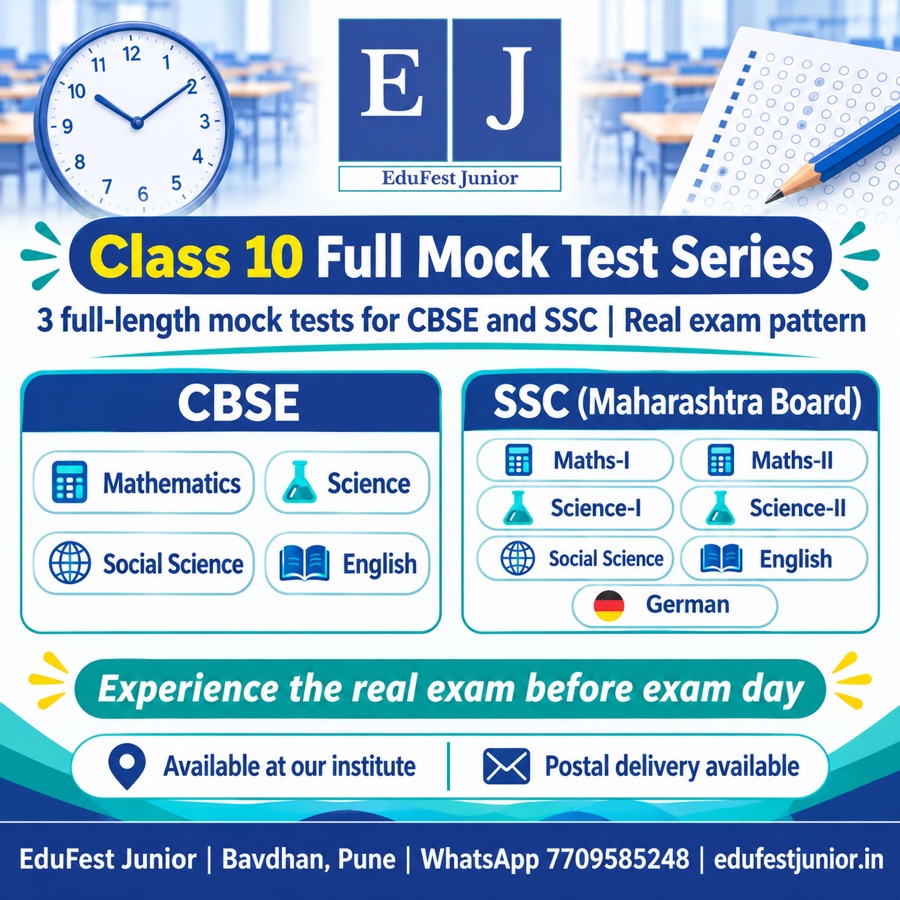
EduFest Junior Academy runs two separate series for Board Exam 2027, both starting 1 Dec 2026, for CBSE and Maharashtra State Board (SSC) students.
The Topic-Wise Test Series gives 10 chapter-wise Mathematics tests per board (Science is coming soon), with concept clarity first, real board-pattern papers, a separate answer key and chapter-wise weak-area diagnosis. Price is available on WhatsApp.
The Full Mock Test Series gives 3 full mock tests per board in real board paper pattern with an answer key, for Rs 4,000 per board. Take them at D-402 Dnyan Manjula, Bavdhan, or by postal delivery across India. WhatsApp 7709585248 or write to support@edufestacademy.in to enquire.
Frequently Asked Questions
Feel The Real Exam Before The Real Exam
Share your name and number and we will WhatsApp you the details of the Class 10 Topic-Wise and Full Mock Test Series.