Complete step-by-step solutions, with diagrams, to every question of the CBSE Class 10 Maths Standard (041) Sample Question Paper 2026-27, explained from the basics and matching the official marking scheme.
Who this guide is for
Class 10 CBSE students and parents in Bavdhan, Pashan, Kothrud, Baner, Warje and Sus preparing for Board Exam 2027.
Class 10 Test Series start 1 Dec 2026
Feel The Real Exam Before The Real Exam
Want to practise full papers like this under exam conditions? Share your name and number and we will WhatsApp you the Class 10 Test Series details.
CBSE Class X Mathematics Standard (041) Sample Question Paper 2026-27
Marks and time
80 marks, 3 hours, 38 questions, all compulsory
Sections
A (20 x 1), B (5 x 2), C (6 x 3), D (4 x 5), E (3 x 4 case studies)
Calculator
Not allowed; take pi as 22/7 unless stated
Source
Official CBSE sample paper and marking scheme, cbseacademic.nic.in
Enquire about the test series
WhatsApp 7709585248 or support@edufestacademy.in
How To Use These Solutions
This is the complete CBSE Class 10 Mathematics Standard (041) Sample Question Paper 2026-27, solved by a teacher, question by question, in the order of the paper. The answers match the official CBSE marking scheme.
Try each question on your own first, with a timer. Then read the solution: every one starts with the Idea (what the question is really testing), then the Steps, then the Answer. Where a diagram helps, you will find one under the question.
Fractions are written stacked, with the top number above the bottom number, so you can read them as in your textbook. The mark split in the CBSE scheme is usually ½ or 1 mark per step, so copy the layout of these steps in your answers.
Section A: Multiple Choice And Assertion-Reason (Q1 to Q20, 1 mark each)
20 marks. Work out each answer on rough paper; do not guess. Most questions take under 90 seconds once the idea is clear.
Q1 (1 mark). The greatest number which divides both 134 and 188, leaving remainders 4 and 6 respectively, is: (A) 13 (B) 26 (C) 39 (D) 65 Idea: if a number leaves remainder 4 when it divides 134, then it divides 134 − 4 exactly. So remove the remainders first, then take the HCF. Step 1: 134 − 4 = 130 and 188 − 6 = 182. Step 2: 130 = 2 × 5 × 13 and 182 = 2 × 7 × 13. Step 3: HCF = 2 × 13 = 26. (It is bigger than both remainders, 4 and 6, as it must be.) Answer: (B) 26
Q2 (1 mark). If f(x) = px² + qx + r, p ≠ 0 and p + r = q, then one of the zeroes of f(x) is: (A) qp (B) rp (C) −rp (D) −qpIdea: replace q by p + r and factorise. Step 1: f(x) = px² + (p + r)x + r = px² + px + rx + r. Step 2: Group: px(x + 1) + r(x + 1) = (x + 1)(px + r). Step 3: Zeroes: x + 1 = 0 gives x = −1, and px + r = 0 gives x = −rp. Answer: (C) −rp
Q3 (1 mark). Tarun found the only point of intersection (5, −1). One line was x − y = 6. Which could be the other line? I: 3x − 3y = 18 II: 2x − 3y = 13 III: 2x − 3y = 16 Idea: the other line must (a) pass through (5, −1) and (b) be a different, non-parallel line, so that (5, −1) is the ONLY common point. Check I: 3(5) − 3(−1) = 18, so it passes through the point. But 3x − 3y = 18 is just x − y = 6 multiplied by 3, the same line, so the lines share every point. Rejected. Check II: 2(5) − 3(−1) = 13, so it passes through the point, and it is not parallel to x − y = 6. Accepted. Check III: 2(5) − 3(−1) = 13, not 16, so the point is not on the line. Rejected. Answer: (B) II only
Q4 (1 mark). If (1 − p) is a root of x² + px + 1 − p = 0, then its roots are: (A) 0, 1 (B) −1, 1 (C) 0, −1 (D) −1, 2 Idea: a root satisfies the equation, so put x = 1 − p in it. Step 1: (1 − p)² + p(1 − p) + 1 − p = 0. Step 2: 1 − 2p + p² + p − p² + 1 − p = 0, so 2 − 2p = 0 and p = 1. Step 3: The equation becomes x² + x + 0 = 0, so x(x + 1) = 0. Roots: x = 0 or x = −1. (Check: 1 − p = 0 is one of them.) Answer: (C) 0, −1
Q5 (1 mark). The middle term of the A.P. 10, 7, 4, …, −62 is: (A) −26 (B) −29 (C) −32 (D) −35 Idea: first find how many terms there are, then pick the middle position. Step 1: a = 10, d = 7 − 10 = −3. Last term = −62. Step 2: aₙ = a + (n − 1)d, so −62 = 10 + (n − 1)(−3). Then −72 = (n − 1)(−3) and n − 1 = 24, so n = 25. Step 3: With 25 terms the middle term is the 25 + 12 = 13th term. Step 4: a₁₃ = 10 + 12 × (−3) = 10 − 36 = −26. Answer: (A) −26
Q6 (1 mark). Perimeters of two similar triangles are 56 cm and 70 cm. If one side of the first is 14 cm, the corresponding side of the second is: (A) 5 (B) 7.5 (C) 10 (D) 17.5 Idea: in similar triangles, the ratio of perimeters = the ratio of corresponding sides. Step 1: 5670 = 14x. Step 2: x = 14 × 7056 = 98056 = 17.5 cm. Answer: (D) 17.5
Q7 (1 mark). The point which lies on the perpendicular bisector of the segment joining A(−3, −4) and B(3, 4) is: (A) (0, 0) (B) (0, 3) (C) (3, 0) (D) (0, 4) Idea: the perpendicular bisector always passes through the midpoint of the segment. Step 1: Midpoint = (−3 + 32, −4 + 42) = (0, 0). Answer: (A) (0, 0)
Q8 (1 mark). If tan(A + B) = √3 and tan(A − B) = 1√3, 0° < A + B < 90°, A > B, then A and B are: (A) 60°, 30° (B) 60°, 45° (C) 45°, 15° (D) 60°, 15° Idea: remember the standard values: tan 60° = √3 and tan 30° = 1√3. Step 1: tan(A + B) = √3, so A + B = 60°. Step 2: tan(A − B) = 1√3, so A − B = 30°. Step 3: Add the two: 2A = 90°, so A = 45°. Subtract: 2B = 30°, so B = 15°. Answer: (C) 45°, 15°
Q9 (1 mark). T-shirts marked 4 to 99 are in a box. P(number is a perfect square or a perfect cube) = ? (A) 112 (B) 132 (C) 1196 (D) 548Idea: count all outcomes, then count favourable ones carefully without counting any number twice. Step 1: Numbers 4 to 99: 99 − 4 + 1 = 96 outcomes. Step 2: Perfect squares: 4, 9, 16, 25, 36, 49, 64, 81, which is 8 numbers. Step 3: Perfect cubes: 8, 27, 64, which is 3 numbers. Step 4: 64 is both a square and a cube, so it was counted twice. Favourable = 8 + 3 − 1 = 10. Step 5: P = 1096 = 548. Answer: (D) 548
Q10 (1 mark). The diameter of a car wheel is 21 cm. The number of complete revolutions it makes in moving 66 km is: (A) 104 (B) 105 (C) 106 (D) 107 Idea: one revolution covers one circumference, so revolutions = distancecircumference. Step 1: Circumference = πd = 227 × 21 = 66 cm. Step 2: Revolutions = total distance in cm66. Note: the official marking scheme gives (B) 105. As the question is printed ("66 km"), the arithmetic gives 100000 revolutions, which is not among the options. The key's 105 corresponds to a distance of 6930 cm (69.3 m). Whatever the printed number, the method above is what earns the marks, and in the exam you should mark the key's option. Answer (as per CBSE marking scheme): (B) 105
Q11 (1 mark). Two cubes of volume 64 cm³ each are joined end to end to form a solid. The surface area of the resultant cuboid is: (A) 192 cm² (B) 160 cm² (C) 96 cm² (D) 80 cm² Idea: find the side of the cube, then the dimensions of the cuboid. Step 1: a³ = 64, so a = 4 cm. Step 2: Joined end to end: length = 4 + 4 = 8 cm, breadth = 4 cm, height = 4 cm. Step 3: TSA of cuboid = 2(lb + bh + hl) = 2(8 × 4 + 4 × 4 + 4 × 8) = 2(32 + 16 + 32) = 160 cm². Answer: (B) 160 cm²
Q12 (1 mark). The mean age of men and women together is 35 years. Mean ages of men and women are 38 and 30 years. The percentage of women is: (A) 15 (B) 25.5 (C) 35 (D) 37.5 Idea: combined mean = total of all agestotal number of people. Step 1: Let there be m men and w women. Then 38m + 30wm + w = 35. Step 2: 38m + 30w = 35m + 35w, so 3m = 5w and m : w = 5 : 3. Step 3: Out of every 8 people, 3 are women. Percentage = 38 × 100 = 37.5%. Answer: (D) 37.5
Q13 (1 mark). Two dice are rolled together. P(a number less than 4 on each die) = ? (A) 14 (B) 19 (C) 136 (D) 16Idea: list what is allowed on EACH die. Step 1: Total outcomes = 6 × 6 = 36. Step 2: Less than 4 means 1, 2 or 3 on each die, so 3 × 3 = 9 favourable outcomes. Step 3: P = 936 = 14. Answer: (A) 14
Q14 (1 mark). PM is a median of ΔPQR with P(5, −6), Q(6, 4), R(0, 0). The length of PM is: (A) 2√17 (B) 2√15 (C) √101 (D) 10 Idea: a median goes from a vertex to the midpoint of the opposite side. So first find the midpoint M of QR. Step 1: M = (6 + 02, 4 + 02) = (3, 2). Step 2: PM = √[(5 − 3)² + (−6 − 2)²] = √(4 + 64) = √68. Step 3: √68 = √(4 × 17) = 2√17. Answer: (A) 2√17 units
Q15 (1 mark). An arc of a circle has length 6π cm and its sector has area 24π cm². The radius is: (A) 4 cm (B) 8 cm (C) 16 cm (D) 18 cm Idea: area of a sector = 12 × arc length × radius. Step 1: 24π = 12 × 6π × r = 3π × r. Step 2: r = 24π3π = 8 cm. Answer: (B) 8 cm
Q16 (1 mark). Mean = 35.5 and median = 32. The mode is: (A) 23 (B) 26 (C) 25 (D) 30 Idea: the empirical formula is Mode = 3 × Median − 2 × Mean. Step 1: Mode = 3(32) − 2(35.5) = 96 − 71 = 25. Answer: (C) 25
Q17 (1 mark). A kite string makes angle θ with the ground, tan θ = 125. The string is 52 m long. The height of the kite is: (A) 40 m (B) 45.5 m (C) 48 m (D) 50 m Idea: tan θ = 125 means a right triangle with opposite side 12 and adjacent side 5. The hypotenuse is √(144 + 25) = 13 (the famous 5-12-13 triangle). Step 1: sin θ = oppositehypotenuse = 1213. Step 2: In the big triangle, sin θ = h52, so h52 = 1213. Step 3: h = 12 × 5213 = 12 × 4 = 48 m. Answer: (C) 48 m
Q18 (1 mark). 2 diamonds and 4 spades are missing from a pack of 52 cards. P(a heart) = ? (A) 1352 (B) 1346 (C) 1152 (D) 1146Idea: the sample space shrinks; the number of hearts does not change. Step 1: Cards left = 52 − (2 + 4) = 46. Step 2: Hearts left = 13 (none was removed). Step 3: P = 1346. Answer: (B) 1346
Q19 (1 mark, Assertion-Reason). A: If three vertices of a parallelogram taken in order are (−1, −6), (2, −5), (7, 2), the fourth vertex is (4, 1). R: Diagonals of a parallelogram bisect each other. Idea: use R to test A. Let the vertices be A(−1, −6), B(2, −5), C(7, 2) and the fourth vertex D(x, y). The diagonals are AC and BD, and they share the same midpoint. Step 1: Midpoint of AC = (−1 + 72, −6 + 22) = (3, −2). Step 2: Midpoint of BD = (2 + x2, −5 + y2). Equate: 2 + x2 = 3 gives x = 4, and −5 + y2 = −2 gives y = 1. Step 3: D = (4, 1), so A is true. R is a true property, and it is exactly what we used. Answer: (A) Both true and R explains A
Q20 (1 mark, Assertion-Reason). A: If the zeroes of (2k − 1)x² + 4x − 3 are reciprocals of each other, then k = −1. R: If a = c, the zeroes of ax² + bx + c are reciprocals of each other. Idea: zeroes α and 1α have product 1, and the product of zeroes is ca. So reciprocal zeroes means a = c. Step 1: Here a = 2k − 1 and c = −3. Set a = c: 2k − 1 = −3, so k = −1. A is true. Step 2: R is the same rule: product = ca = 1 when a = c, so R is true and it explains A. Answer: (A) Both true and R explains A
Section B: Very Short Answer (Q21 to Q25, 2 marks each)
10 marks. Two questions have an either-or choice. Two marks usually means two or three clear steps.
Q21(A) (2 marks). A hall is 9.75 m long, 6.75 m broad and 5.25 m high. Find the length of the longest unmarked ruler that can exactly measure all three dimensions. Idea: the longest ruler that fits each length a whole number of times is the HCF. Step 1: Convert to cm: 975 cm, 675 cm, 525 cm. Step 2: Prime factors: 975 = 3 × 5² × 13; 675 = 3³ × 5²; 525 = 3 × 5² × 7. Step 3: HCF = common factors with the smallest powers = 3 × 5² = 75. Answer: 75 cm (0.75 m)
Q21(B) (2 marks, OR). Three bells toll every 5, 6 and 8 minutes. They toll together at 10:00 a.m. when the park opens. How many more times do they toll together before the park closes at 7:00 p.m.? Idea: they toll together again after the LCM of the three intervals. Step 1: LCM(5, 6, 8) = 120 minutes = 2 hours. Step 2: Times after 10:00 a.m.: 12:00 noon, 2:00 p.m., 4:00 p.m., 6:00 p.m. The next one would be 8:00 p.m., after closing. Answer: 4 more times
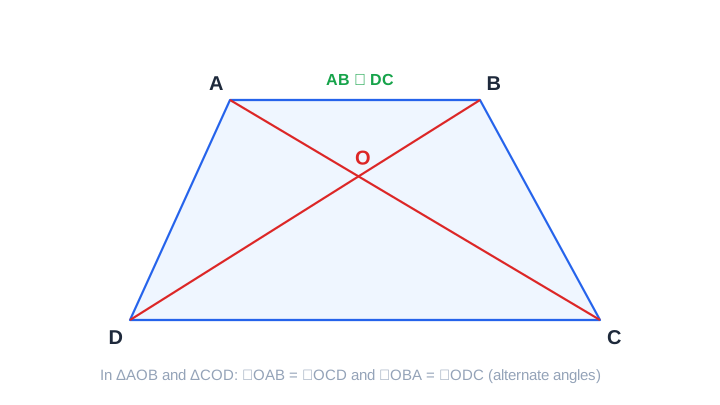
Q22(A) (2 marks). ABCD is a trapezium, AB ∥ DC, and the diagonals meet at O. Show that AOBO = CODO. Idea: spot two similar triangles using the parallel sides. Step 1: In ΔAOB and ΔCOD: ∠OAB = ∠OCD and ∠OBA = ∠ODC (alternate interior angles, because AB ∥ DC). Step 2: So ΔAOB ∼ ΔCOD by the AA criterion. Step 3: Corresponding sides are proportional: AOCO = BODO. Step 4: Swap the means (cross-multiply and rearrange): AOBO = CODO. Hence proved.
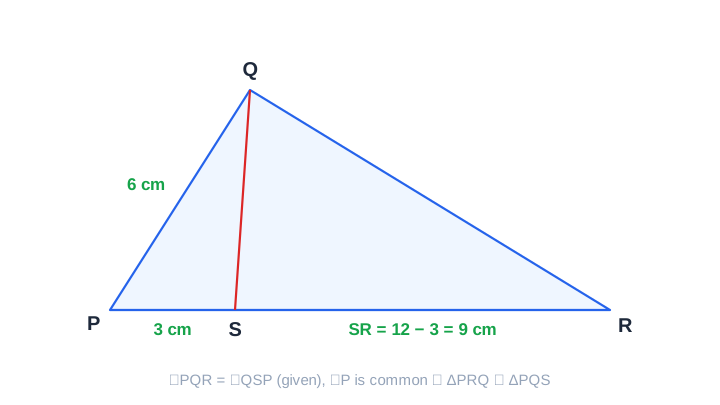
Q22(B) (2 marks, OR). In the figure, ∠PQR = ∠QSP, PQ = 6 cm and PS = 3 cm. Find PR. Idea: two angles equal means similar triangles (AA), and similar triangles give equal ratios of sides. Step 1: In ΔPRQ and ΔPQS: ∠PQR = ∠QSP (given) and ∠QPR = ∠QPS (common angle). Step 2: So ΔPRQ ∼ ΔPQS by AA. Step 3: PQPS = PRPQ, so 63 = PR6. Step 4: PR = 6 × 63 = 12 cm. For visually impaired candidates (BCD ∼ ACB): in ΔBCD and ΔACB, ∠BDC = ∠ABC = 90° and ∠BCD = ∠ACB (common). So ΔBCD ∼ ΔACB by AA. Answer: PR = 12 cm
Q23 (2 marks). If tan θ = 1√5, find cosec²θ − sec²θcosec²θ + sec²θ. Idea: convert both squares into tan θ or cot θ using the identities sec²θ = 1 + tan²θ and cosec²θ = 1 + cot²θ. Step 1: tan θ = 1√5, so tan²θ = 15 and cot²θ = 5. Step 2: sec²θ = 1 + 15 = 65. Step 3: cosec²θ = 1 + 5 = 6. Step 4: Numerator = 6 − 65 = 245. Denominator = 6 + 65 = 365. Step 5: Ratio = 245 × 536 = 2436 = 23. Answer: 23
Q24 (2 marks). Find the area of a sector of a circle of diameter 28 cm if the length of the corresponding arc is 22 cm. Idea: area of sector = 12 × arc length × radius. Step 1: Radius = 282 = 14 cm. Step 2: Area = 12 × 22 × 14 = 154 cm². Answer: 154 cm²
Q25 (2 marks). Two dice are thrown together. Find the probability that the product of the two numbers is a prime number. Idea: a prime has exactly two factors, 1 and itself. A product of two numbers is prime only when one number is 1 and the other is a prime. Step 1: Total outcomes = 36. Step 2: Favourable: (1, 2), (2, 1), (1, 3), (3, 1), (1, 5), (5, 1), which is 6 outcomes. (Note 1 × 1 = 1 is not prime, and 1 × 4 or 1 × 6 give non-primes.) Step 3: P = 636 = 16. Answer: 16
Section C: Short Answer (Q26 to Q31, 3 marks each)
18 marks. Proofs and identities need reasons written in words. Q28 and Q31 have an either-or choice.
Q26 (3 marks). Given that √3 is irrational, prove that 2 + 3√3 is irrational. Idea: proof by contradiction. Assume it IS rational and show that this forces √3 to be rational, which we know is false. Step 1: Assume 2 + 3√3 = ab, where a and b are integers and b ≠ 0. Step 2: 3√3 = ab − 2 = a − 2bb, so √3 = a − 2b3b. Step 3: a and b are integers, so a − 2b3b is a rational number. That makes √3 rational, which contradicts the given fact. Step 4: So our assumption was wrong. Hence 2 + 3√3 is irrational.
Q27 (3 marks). If α and β are the zeroes of 2x² − 8x + 5, find (α + 1β) × (β + 1α). Idea: get the sum and product of zeroes from the coefficients (a = 2, b = −8, c = 5), then simplify the expression using only αβ. Step 1: α + β = −ba = 82 = 4 and αβ = ca = 52. Step 2: α + 1β = αβ + 1β and β + 1α = αβ + 1α. Step 3: Product = (αβ + 1)²αβ. Step 4: αβ + 1 = 52 + 1 = 72, so (αβ + 1)² = 494. Step 5: 494 × 25 = 9820 = 4910. Answer: 4910
Q28(A) (3 marks). Ridhi drew an n-sided polygon. The smallest exterior angle is 8° and each next exterior angle is 4° more than the previous one. Find n. Idea: the exterior angles of ANY polygon add up to 360°, and here they form an A.P. with a = 8 and d = 4. Step 1: Sₙ = n2[2a + (n − 1)d] = n2[16 + 4(n − 1)] = n2(4n + 12) = 2n² + 6n. Step 2: 2n² + 6n = 360, so n² + 3n − 180 = 0. Step 3: Factorise: (n + 15)(n − 12) = 0, so n = −15 or n = 12. Step 4: Number of sides cannot be negative, so n = 12. Answer: 12 sides
Q28(B) (3 marks, OR). Find the sum of the integers between 1 and 400 that are multiples of 4 as well as of 5. Idea: multiples of both 4 and 5 are multiples of their LCM, 20. Step 1: The list is 20, 40, 60, …, 380 (the next, 400, is not between 1 and 400). It is an A.P. with a = 20, d = 20. Step 2: 380 = 20 + (n − 1) × 20, so n − 1 = 18 and n = 19. Step 3: S₁₉ = 192(20 + 380) = 192 × 400 = 3800. Answer: 3800
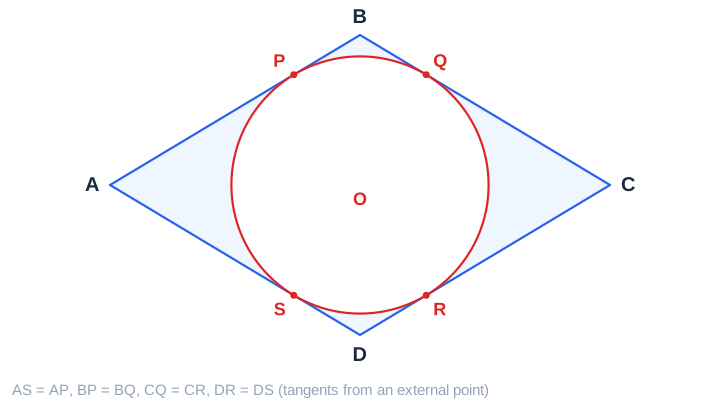
Q29 (3 marks). Prove that a parallelogram circumscribing a circle is a rhombus. Idea: tangents drawn from one outside point to a circle are equal in length. Use this at all four corners. Step 1: Let the circle touch AB, BC, CD, DA at P, Q, R, S. Tangents drawn from one outside point are equal, so AP = AS, BP = BQ, CR = CQ and DR = DS. Step 2: Add all four: (AP + BP) + (CR + DR) = (AS + DS) + (BQ + CQ), which gives AB + CD = AD + BC. Step 3: In a parallelogram opposite sides are equal: AB = CD and AD = BC. So 2AB = 2AD, hence AB = AD. Step 4: A parallelogram with two adjacent sides equal is a rhombus. Hence proved.
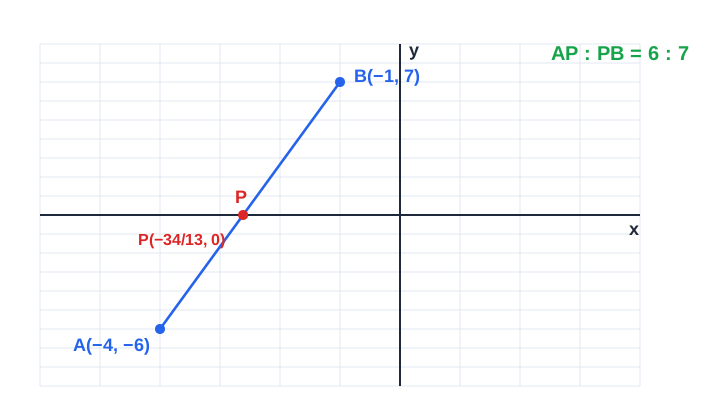
Q30 (3 marks). In what ratio does the x-axis divide the segment joining (−4, −6) and (−1, 7)? Also find the point of division. Idea: any point on the x-axis has y = 0. Use the section formula with ratio k : 1 and force the y-coordinate to be 0. Step 1: Let P divide A(−4, −6) and B(−1, 7) in the ratio k : 1. The y-coordinate of P is 7k + (−6)k + 1 = 7k − 6k + 1. Step 2: Put it equal to 0: 7k − 6 = 0, so k = 67. The ratio is 6 : 7. Step 3: Now the x-coordinate with ratio 6 : 7: x = 6(−1) + 7(−4)6 + 7 = −6 − 2813 = −3413. Answer: ratio 6 : 7 and the point is (−3413, 0)
Q31(A) (3 marks). Jyoti simplified cos θ1 − sin θ + 1 − sin θcos θ in four steps: step 1 gave cos²θ + (1 − sin θ)²(1 − sin θ) × cos θ; step 2 gave cos²θ + cos²θ(1 − sin θ) × cos θ. Find the step with the error, and the correct answer. Idea: check each step against the algebra rules. Step 1 is correct: the common denominator is (1 − sin θ) × cos θ. The error is in step 2. She replaced (1 − sin θ)² by cos²θ, but (1 − sin θ)² = 1 − 2 sin θ + sin²θ, which is NOT equal to cos²θ (that would be 1 − sin²θ). Correct working: Numerator = cos²θ + 1 − 2 sin θ + sin²θ = (cos²θ + sin²θ) + 1 − 2 sin θ = 1 + 1 − 2 sin θ = 2 − 2 sin θ = 2(1 − sin θ). So the whole expression = 2(1 − sin θ)(1 − sin θ) × cos θ = 2cos θ = 2 sec θ. Answer: error in step 2; correct answer 2 sec θ
Q31(B) (3 marks, OR). If 1sin x − cos x = cosec x√2, prove that (1sin x + cos x)² = sec²x2. Idea: use the given condition to get a relation between sin x and cos x, then rewrite the left side. Step 1: cosec x = 1sin x, so 1sin x − cos x = 1√2 sin x. Hence sin x − cos x = √2 sin x. Step 2: Square both sides: sin²x − 2 sin x cos x + cos²x = 2 sin²x, so 1 − 2 sin x cos x = 2 sin²x. Step 3: Therefore 2 sin x cos x = 1 − 2 sin²x. … (i) Step 4: LHS = (1sin x + cos x)² = 1sin²x + 2 sin x cos x + cos²x = 11 + 2 sin x cos x. Step 5: Put (i): 1 + 2 sin x cos x = 1 + 1 − 2 sin²x = 2 − 2 sin²x = 2cos²x. Step 6: LHS = 12cos²x = sec²x2 = RHS. Hence proved.
Section D: Long Answer (Q32 to Q35, 5 marks each)
20 marks. Q34 and Q35 have an either-or choice. Draw the figure first; it earns a mark in Q33 and Q35.
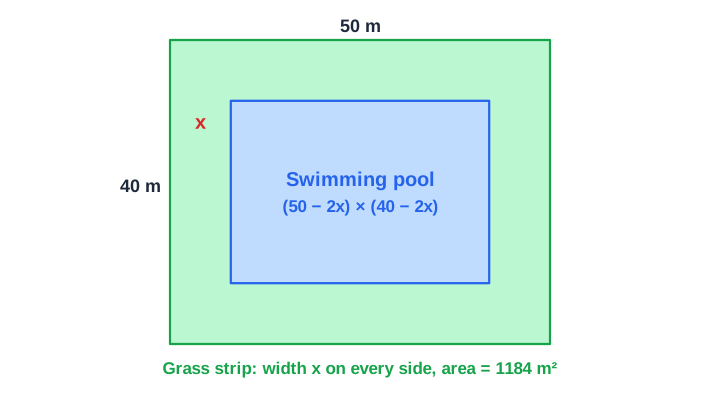
Q32 (5 marks). A 50 m × 40 m rectangular park has a swimming pool in the middle, surrounded by a grass strip of uniform width. The grass strip has area 1184 m². Find the dimensions of the pool. Idea: let the strip width be x. The pool then loses x from each side, so each dimension drops by 2x. Step 1: Pool length = (50 − 2x) m and pool breadth = (40 − 2x) m. Step 2: Grass area = Park area − Pool area, so 50 × 40 − (50 − 2x)(40 − 2x) = 1184. Step 3: Expand (50 − 2x)(40 − 2x) = 2000 − 180x + 4x². So 2000 − 2000 + 180x − 4x² = 1184, i.e. 4x² − 180x + 1184 = 0. Step 4: Divide by 4: x² − 45x + 296 = 0. Factorise: (x − 8)(x − 37) = 0, so x = 8 or x = 37. Step 5: x = 37 is impossible (the park is only 40 m wide, so 2x must be less than 40). Hence x = 8. Step 6: Pool = (50 − 16) × (40 − 16) = 34 m × 24 m. Check: 2000 − 816 = 1184 ✓. Answer: 34 m by 24 m
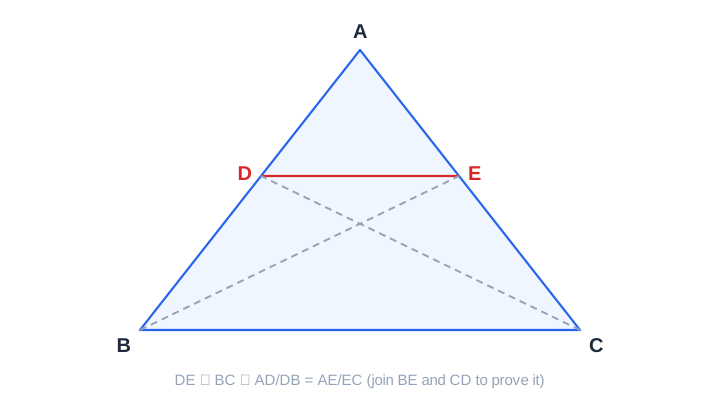
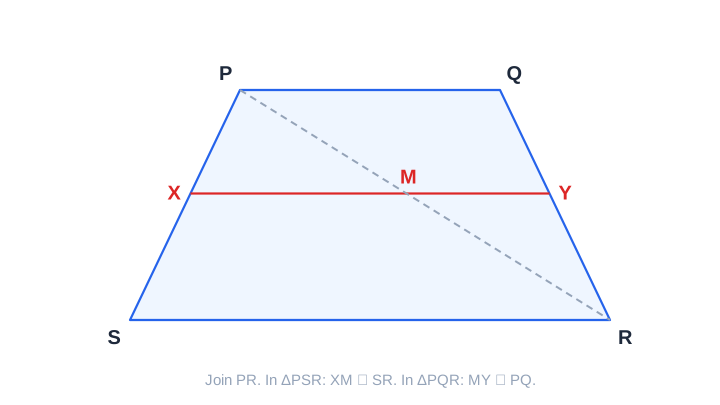
Q33 (5 marks). Prove that a line drawn parallel to one side of a triangle, cutting the other two sides in distinct points, divides them in the same ratio (Basic Proportionality Theorem). Use it to show: in trapezium PQRS with PQ ∥ SR, X on PS and Y on QR with XY ∥ PQ, PXXS = QYYR. Part 1 (the theorem). Given: ΔABC with DE ∥ BC, D on AB and E on AC. To prove: ADDB = AEEC. Construction: join BE and CD, and draw EF ⊥ AB and DG ⊥ AC. Step 1: Triangles ADE and BDE share the height EF. So ar(ADE)ar(BDE) = ½ × AD × EF½ × DB × EF = ADDB. … (1) Step 2: Similarly, triangles ADE and CDE share the height DG. So ar(ADE)ar(CDE) = AEEC. … (2) Step 3: Triangles BDE and CDE are on the same base DE and between the same parallels DE and BC, so ar(BDE) = ar(CDE). … (3) Step 4: From (1), (2), (3): ADDB = AEEC. Hence proved.
Q33, part 2 (the trapezium). Idea: join the diagonal PR so that two triangles appear, then use the theorem in each. Step 1: Join PR to meet XY at M. Step 2: In ΔPSR, XM ∥ SR (because XY ∥ PQ ∥ SR). By the theorem, PXXS = PMMR. … (i) Step 3: In ΔPQR, MY ∥ PQ. By the theorem, QYYR = PMMR. … (ii) Step 4: The right sides of (i) and (ii) are equal, so PXXS = QYYR. Hence proved.
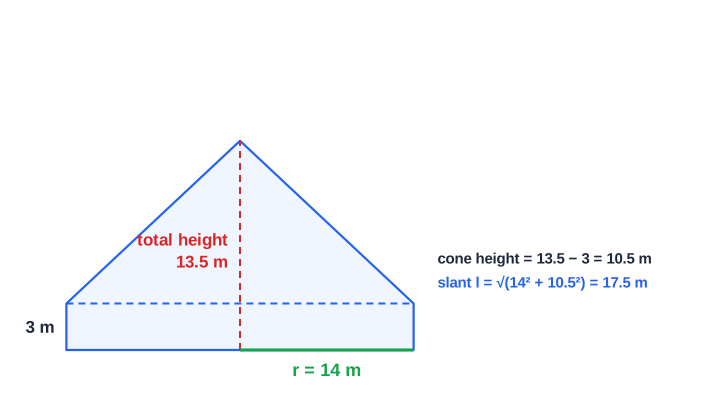
Q34(A) (5 marks). A tent is a cylinder topped by a cone. The cylinder has height 3 m and radius 14 m; the total height is 13.5 m. Find the canvas needed (with 26 m² extra for stitching and wastage) and its cost at ₹250 per m². Idea: canvas = curved surface of the cone + curved surface of the cylinder (no base, no circle on top) + the extra 26 m². Step 1: Cone height = 13.5 − 3 = 10.5 m. Step 2: Slant height l = √(r² + h²) = √(14² + 10.5²) = √(196 + 110.25) = √306.25 = 17.5 m. Step 3: CSA of cone = πrl = 227 × 14 × 17.5 = 22 × 2 × 17.5 = 770 m². Step 4: CSA of cylinder = 2πrh = 2 × 227 × 14 × 3 = 264 m². Step 5: Canvas = 770 + 264 + 26 = 1060 m². Step 6: Cost = 1060 × 250 = ₹2,65,000. Answer: 1060 m² of canvas, costing ₹2,65,000
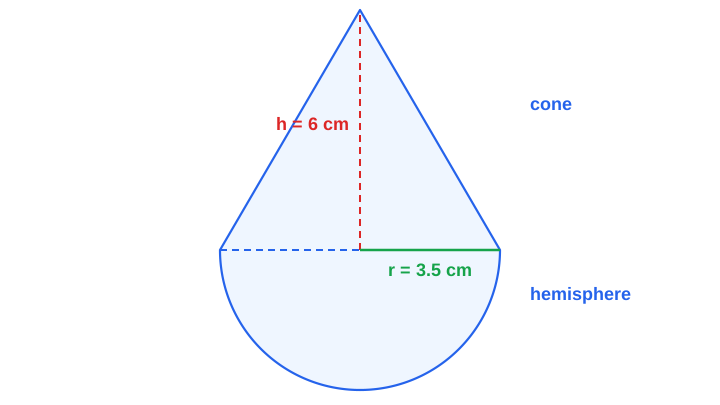
Q34(B) (5 marks, OR). A wooden toy is a cone on a hemisphere of the same radius 3.5 cm. The wood used is 16656 cm³. Find the height of the cone, and the cost of painting the hemispherical part at ₹15 per cm². Idea: wood used = volume of cone + volume of hemisphere. Convert 16656 to an improper fraction: 16656 = 10016. Step 1: r = 3.5 = 72. Volume of cone = 13πr²h = 13 × 227 × 494 × h = 776h. Step 2: Volume of hemisphere = 23πr³ = 23 × 227 × 3438 = 5396. Step 3: 776h + 5396 = 10016, so 77h = 1001 − 539 = 462 and h = 6 cm. Step 4: CSA of hemisphere = 2πr² = 2 × 227 × 494 = 77 cm². Step 5: Cost = 77 × 15 = ₹1155. Answer: height 6 cm; painting cost ₹1155
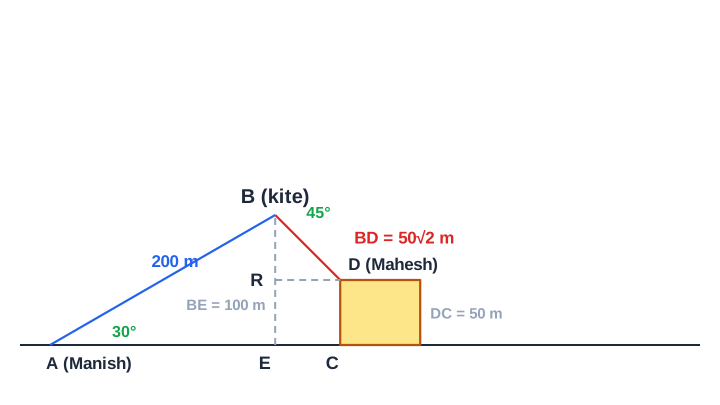
Q35(A) (5 marks). Manish stands on level ground and sees a kite 200 m away at 30° elevation. Mahesh, on a 50 m high building on the opposite side of the kite, sees the same kite at 45° elevation. Find the distance between the kite and Mahesh. Idea: first find the kite's height above the ground from Manish's right triangle, then use Mahesh's right triangle. Step 1: In right ΔAEB (A is Manish, E the foot of the kite, B the kite): BEAB = sin 30° = 12, so BE = 2002 = 100 m. Step 2: Mahesh's eye is 50 m above the ground (DC = 50 m = RE). So the kite is above his level by BR = BE − RE = 100 − 50 = 50 m. Step 3: In right ΔBRD: BRBD = sin 45° = 1√2, so 50BD = 1√2 and BD = 50√2 m. Answer: 50√2 m (about 70.7 m)
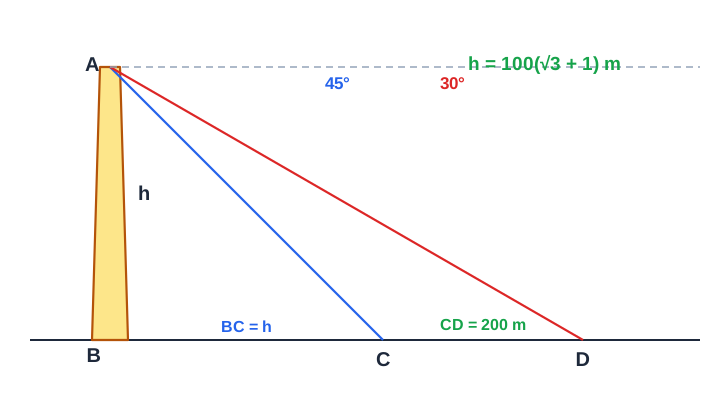
Q35(B) (5 marks, OR). The angles of depression of two ships from the top of a lighthouse (same side) are 45° and 30°. The ships are 200 m apart, one exactly behind the other. Find the height of the lighthouse. Idea: the angle of depression from the top equals the angle of elevation of the top from the ship (alternate angles). Let the height be h and the nearer ship be at C, the farther at D. Step 1: In right ΔABC: hBC = tan 45° = 1, so BC = h. Step 2: In right ΔABD: hh + 200 = tan 30° = 1√3. Step 3: √3 h = h + 200, so h(√3 − 1) = 200 and h = 200√3 − 1. Step 4: Rationalise by multiplying top and bottom by (√3 + 1): h = 200(√3 + 1)(√3)² − 1² = 200(√3 + 1)2 = 100(√3 + 1). Answer: 100(√3 + 1) m (about 273.2 m)
Section E: Case Studies (Q36 to Q38, 4 marks each)
12 marks. Each case study has three parts worth 1, 1 and 2 marks, and the 2-mark part has an either-or choice.
Q36 (4 marks, case study: sanitizer bottles). Small bottle ₹10, large ₹15. In June 1000 bottles gave ₹12,750 of sales. Prices then rose by ₹2 each, and in July 2500 bottles gave ₹34,250. Let x = number of small and y = number of large bottles. (i) June sales equation (1 mark): 10x + 15y = 12750 (or 2x + 3y = 2550). (ii) July sales equation (1 mark): new prices are ₹12 and ₹17, so 12x + 17y = 34250. (iii)(A) Bottles sold in June (2 marks): x + y = 1000 … (1) and 10x + 15y = 12750 … (2). Multiply (1) by 10: 10x + 10y = 10000. Subtract from (2): 5y = 2750, so y = 550. Then x = 1000 − 550 = 450. 450 small and 550 large bottles. Check: 4500 + 8250 = 12750 ✓. (iii)(B) OR, bottles sold in July (2 marks): x + y = 2500 and 12x + 17y = 34250. Multiply the first by 12: 12x + 12y = 30000. Subtract: 5y = 4250, so y = 850 and x = 1650. 1650 small and 850 large bottles. Check: 19800 + 14450 = 34250 ✓.
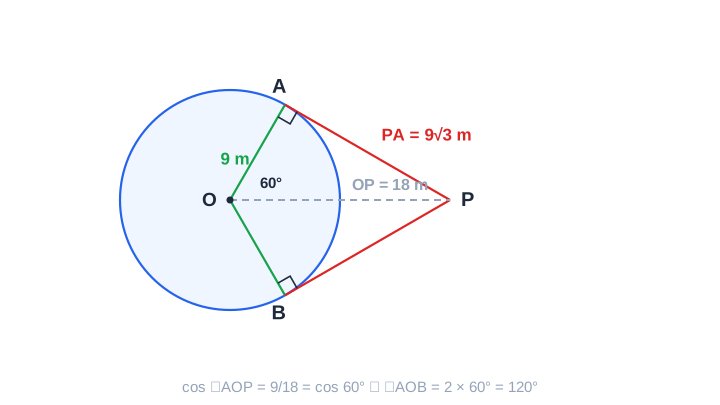
Q37 (4 marks, case study: circular garden). Arjun stands at P outside a circular garden (centre O, radius 9 m, OP = 18 m) and draws tangents PA and PB. (i) ∠OAP (1 mark): the radius to the point of contact is perpendicular to the tangent, so ∠OAP = 90°. (ii) Length PA (1 mark): in right ΔOAP, OP² = OA² + AP², so 18² = 9² + AP². AP² = 324 − 81 = 243 and AP = √243 = 9√3 m. (iii)(A) ∠AOB (2 marks): in right ΔOAP, cos ∠AOP = OAOP = 918 = 12 = cos 60°, so ∠AOP = 60°. OP bisects ∠AOB, so ∠AOB = 2 × 60° = 120°. (iii)(B) OR, if the tangents are inclined at 60° (2 marks): OP bisects ∠APB, so ∠OPA = 12 × 60° = 30°. In right ΔOPA, tan 30° = OAAP, so 1√3 = 9AP and AP = 9√3 m.
Q38 (4 marks, case study: weekly test marks out of 50). Marks 0–10, 10–20, 20–30, 30–40, 40–50 with 3, 6, 12, 15, 14 students. (i) Modal class (1 mark): the class with the highest frequency (15) is 30 – 40. (ii) Median class (1 mark): N = 3 + 6 + 12 + 15 + 14 = 50, so N2 = 25. Cumulative frequencies: 3, 9, 21, 36, 50. The first cumulative frequency above 25 is 36, so the median class is 30 – 40. (iii)(A) Mean (2 marks): class marks x: 5, 15, 25, 35, 45. Then f × x: 15, 90, 300, 525, 630. Total = 1560. Mean = 156050 = 31.2. (iii)(B) OR, Mode (2 marks): modal class 30 – 40, so l = 30, h = 10, f₁ = 15, f₀ = 12, f₂ = 14. Mode = l + (f₁ − f₀2f₁ − f₀ − f₂) × h = 30 + (15 − 1230 − 12 − 14) × 10 = 30 + 34 × 10 = 37.5.
Five Answer-Writing Habits That Earn Marks
1. Write the formula before you use it. CBSE schemes give a mark for the formula or the correct equation. Writing it first secures that mark.
2. Show each substitution. Put the numbers in on a separate line, then simplify. The examiner follows your method even if you slip in arithmetic.
3. State the reason in geometry. Write why a step is true, for example "tangents from an external point are equal" or "AA criterion". Each reason is a mark.
4. Reject the extra root. In word problems with quadratics, one root is usually impossible (negative speed, negative width). Say so and keep the valid one.
5. Finish with a sentence and units. End with a line like "The speed of the train is 40 km/h". It completes the answer and avoids losing the last mark.
Everything in this article is based on the Sample Question Papers and Marking Schemes for Class X (2026-27), Mathematics Standard (041) and Mathematics Basic (241), published by the Central Board of Secondary Education on cbseacademic.nic.in. Marks and the paper design are as printed by CBSE.
The tagging of each question to a chapter is our own reading as teachers. A few questions use ideas from two chapters (for example the case study on a circular garden uses both tangents and Pythagoras), so another teacher may tag one or two questions differently.
Ready To Try A Full Paper Like This Under Exam Conditions?
Reading a solution is not the same as writing the paper in 3 hours. Once you have studied the method here, test yourself on fresh papers: chapter-wise tests first to find the weak chapter, then full mock tests in the real board pattern.
Two Class 10 Test Series At EduFest, Bavdhan, Pune
EduFest Junior Academy runs two separate series for Board Exam 2027, both starting 1 Dec 2026, for CBSE and Maharashtra State Board (SSC) students.
The Topic-Wise Test Series gives 10 chapter-wise Mathematics tests per board (Science is coming soon), with concept clarity first, real board-pattern papers, a separate answer key and chapter-wise weak-area diagnosis. Price is available on WhatsApp.
The Full Mock Test Series gives 3 full mock tests per board in real board paper pattern with an answer key, for Rs 4,000 per board. Take them at D-402 Dnyan Manjula, Bavdhan, or by postal delivery across India. WhatsApp 7709585248 or write to support@edufestacademy.in to enquire.
Frequently Asked Questions
The answers match the official CBSE marking scheme. The explanations, diagrams and working in simple language are written by EduFest teachers to help students understand the method.
There are 38 questions for 80 marks in 3 hours: 20 one-mark questions in Section A, 5 two-mark questions in B, 6 three-mark in C, 4 five-mark in D and 3 four-mark case studies in E.
No. Calculators are not allowed in the exam, and the paper says to take π as 22/7 if not stated. All the solutions here can be done by hand.
See our analysis of both 2026-27 sample papers, which gives chapter-wise and unit-wise marks and a preparation plan: /blog/Boards/cbse-class-10-maths-sample-paper-2026-27-analysis.
The EduFest Full Mock Test Series has 3 full mock tests per board in the real board pattern (Rs 4,000 per board), and the Topic-Wise Test Series has 10 chapter-wise Maths tests per board. WhatsApp 7709585248.
Class 10 Topic-Wise Test Series and Full Mock Test Series for Board Exam 2027 start 1 Dec 2026: 10 chapter-wise Maths tests per board, then 3 full mocks per board, for CBSE and Maharashtra SSC. At our Bavdhan institute or by post across India. WhatsApp 7709585248.
Class 10 Test Series start 1 Dec 2026
Feel The Real Exam Before The Real Exam
Want to practise full papers like this under exam conditions? Share your name and number and we will WhatsApp you the Class 10 Test Series details.
TE
Team EduFest
EduFest Junior Academy — educators helping Class 5–10 students in Bavdhan, Pune build subject confidence through small-batch offline tuition and Olympiad preparation.