A teacher's analysis of the CBSE Class 10 Sanskrit Communicative (119) sample paper 2026-27: the unchanged pattern, marks for unseen comprehension, guided writing, applied grammar and textbook questions, and a 4-week study plan for Board Exam 2027.
Feel The Real Exam Before The Real Exam
Share your name and number and we will WhatsApp you the details of the Class 10 Topic-Wise and Full Mock Test Series.
Quick Facts
| Paper | CBSE Class X Sanskrit Communicative (119) Sample Question Paper 2026-27, with marking scheme |
|---|---|
| Marks and time | 80 marks, 3 hours, 18 questions, all compulsory |
| Sections | क Unseen (10), ख Creative writing (15), ग Applied grammar (25), घ Textbooks (30) |
| Pattern change | None for 2026-27, as printed by CBSE |
| Source | Official CBSE sample paper and marking scheme, cbseacademic.nic.in |
| Enquire about the test series | WhatsApp 7709585248 or support@edufestacademy.in |
The Short Version
If you only have a minute: the Sanskrit Communicative paper for 2026-27 has 18 questions for 80 marks in 3 hours, in four sections: Unseen comprehension (भाग क, 10 marks), Creative writing (भाग ख, 15), Applied grammar (भाग ग, 25) and Textbooks (भाग घ, 30). CBSE prints that there is no change in the assessment pattern for 2026-27.
What it means for you: this paper is built around guided writing and word boxes, so a student who learns the textbook vocabulary and the grammar rules can score very well. Most of the writing marks go to correct sentences and not to long answers.
The Paper Pattern
The paper has four sections. All answers are written in Sanskrit, and several questions give a choice.
| Section | Questions | Content | Marks |
|---|---|---|---|
| क: Unseen comprehension | Q1 | One passage: one-word and full-sentence answers, title, 'as directed' | 10 |
| ख: Creative writing | Q2 to Q4 | Letter completion (5), picture description or paragraph (5), dialogue or story completion (5) | 15 |
| ग: Applied grammar | Q5 to Q7 | Sandhi, samasa, pratyaya (4 marks each) | 12 |
| ग: Applied grammar | Q8 to Q11 | Voice (3), time (3), indeclinables (4), error correction (3) | 13 |
| घ: Textbooks | Q12 to Q14 | Prose, verse and drama passages (5 marks each) | 15 |
| घ: Textbooks | Q15 to Q18 | Question making (5), anvaya or bhavartha (2), meaning in context (4), story completion (4) | 15 |
| Total | 18 questions | 80 |
Section-Wise Marks
Textbooks carry the most marks, and applied grammar is the most predictable section.
| Section / unit | Marks |
|---|---|
| Section A (भाग क): Unseen Comprehension | 10 |
| Section B (भाग ख): Creative Writing | 15 |
| Section C (भाग ग): Applied Grammar | 25 |
| Section D (भाग घ): Textbooks | 30 |
| Total | 80 |
Chapter-Wise Marks (Our Tagging)
We tagged each question to a chapter or skill and added up the marks. The list runs from the most marks to the least.
| Chapter / area | Questions | Marks | Share of paper |
|---|---|---|---|
| Unseen Passage (अपठितावबोधनम्) | Q1 | 10 | 12.5% |
| Letter Completion (पत्रपूर्तिः) | Q2 | 5 | 6.2% |
| Picture Description or Paragraph (चित्रवर्णनम् / अनुच्छेदलेखनम्) | Q3 | 5 | 6.2% |
| Dialogue or Story Completion (संवादपूर्तिः / कथापूर्तिः) | Q4 | 5 | 6.2% |
| Textbook: Prose (गद्यांशः) | Q12 | 5 | 6.2% |
| Textbook: Verse (पद्यांशः) | Q13 | 5 | 6.2% |
| Textbook: Drama (नाट्यांशः) | Q14 | 5 | 6.2% |
| Textbook: Question Making (प्रश्ननिर्माणम्) | Q15 | 5 | 6.2% |
| Grammar: Sandhi (सन्धिः) | Q5 | 4 | 5.0% |
| Grammar: Samasa (समासः) | Q6 | 4 | 5.0% |
| Grammar: Pratyaya (प्रत्ययाः) | Q7 | 4 | 5.0% |
| Grammar: Indeclinables (अव्ययपदानि) | Q10 | 4 | 5.0% |
| Textbook: Meaning in Context (प्रसङ्गानुकूलम् उचितार्थचयनम्) | Q17 | 4 | 5.0% |
| Textbook: Story Completion (पठितकथा-पूर्तिः) | Q18 | 4 | 5.0% |
| Grammar: Voice (वाच्यम्) | Q8 | 3 | 3.8% |
| Grammar: Time (समयः) | Q9 | 3 | 3.8% |
| Grammar: Error Correction (अशुद्धिसंशोधनम्) | Q11 | 3 | 3.8% |
| Textbook: Anvaya or Bhavartha (अन्वयः / भावार्थः) | Q16 | 2 | 2.5% |
| Total | 18 questions | 80 | 100% |
What The Numbers Tell Us
- Textbooks are 30 of 80 marks (37.5%). The three extracts (prose, verse, drama) follow a fixed pattern: one-word answers, full-sentence answers and two 'as directed' questions.
- Applied grammar is 25 marks. Eleven marks are multiple choice (samasa, pratyaya and error correction), and the rest are fill-ins with a fixed answer, so these are safe marks.
- Q2 (letter) and Q4 (dialogue or story) are fill-in questions from a word box. Each blank is worth half a mark in the letter and in the story, so reading the sentence for meaning is enough.
- Q16 is only 2 marks (four blanks at half a mark each), and Q18 is a story with eight blanks from a box. These are easy marks if you have read the lesson.
- For the picture or paragraph question the scheme looks only at sentence correctness. Five short, correct sentences are better than long ones with errors.
- Time (Q9) and indeclinables (Q10) are short questions with fixed answers. Learn the time words from sapada to pAdona, and the common avyayas.
How The Marks Are Really Given
- In the one-word answers, each correct answer earns half a mark. The answer must be one word, not a sentence.
- In the full-sentence answers, a complete and correct Sanskrit sentence earns the mark. Incomplete sentences earn part of it.
- The scheme says that for the picture and paragraph questions, five correct sentences are enough, and the word box is only a help.
- The scheme says partial marks are given for grammar errors, and it does not take away the full marks.
A 4-Week Study Plan For Class 10 Sanskrit Communicative
This plan assumes about 1 hour of Sanskrit a day. Grammar goes first, because it is the quickest to score.
- Week 1: Grammar rules. Day 1-2: sandhi (guna, vriddhi, yan, ayadi, visarga, vyanjan). Day 3: samasa (dvandva, tatpurusha, bahuvrihi, avyayibhava, nan). Day 4: pratyaya (tap, matup, tal, aniyar, ktva, lyap). Day 5: voice and verb forms. Day 6: time and avyaya. Day 7: error correction.
- Week 2: Textbook prose and verse. Revise each lesson in Abhyasvan Bhava: summary in Sanskrit, difficult words and the important shlokas. Practise one-word and full-sentence questions on each lesson, and memorise the shlokas with their anvaya.
- Week 3: Drama, stories and unseen passage. Revise the drama lesson, then practise story completion (the Shibi story and the elephant story) and question making. Read one unseen passage a day and answer the five question types.
- Week 4: Writing, practice and polish. Practise letter completion, dialogue completion, picture description and a five-sentence paragraph. Then write the full sample paper in 3 hours and mark it with the official scheme. Revise your weakest section and take a second timed paper.
- Every day: a 10-minute habit. Write five sentences in Sanskrit about your day. It builds vocabulary and verb forms, which help in every section.
Step-By-Step Solutions To The Full Paper
We have solved the complete paper, in the order of the paper, and matched the answers to the official marking scheme. Try the paper yourself first, then use the solutions.
Where This Paper Comes From
Everything here is based on the Sample Question Paper and Marking Scheme for Class X (2026-27), Sanskrit Communicative (119), published by the Central Board of Secondary Education on cbseacademic.nic.in. Marks and the paper design are as printed by CBSE.
The tagging of each question to a chapter or skill is our own reading as teachers. Some questions use ideas from more than one chapter, so another teacher may tag one or two questions differently.
Ready To Try A Full Paper Under Exam Conditions?
Reading a solution is not the same as writing the paper in the exam hall. Use chapter-wise tests to find your weak chapter, then full mock tests in the real board pattern.
Two Class 10 Test Series At EduFest, Bavdhan, Pune
EduFest Junior Academy runs two separate series for Board Exam 2027, both starting 1 Dec 2026, for CBSE and Maharashtra State Board (SSC) students.
The Topic-Wise Test Series gives 10 chapter-wise Mathematics tests per board (Science is coming soon), with concept clarity first, real board-pattern papers, a separate answer key and chapter-wise weak-area diagnosis. Price is available on WhatsApp.
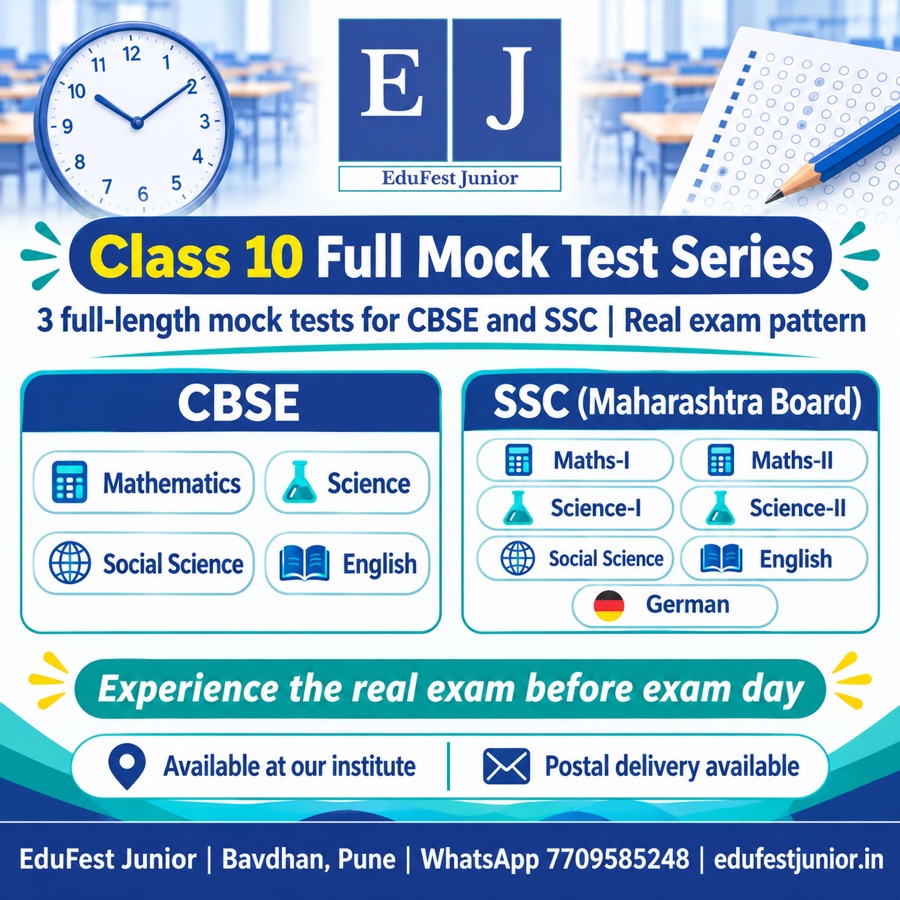
The Full Mock Test Series gives 3 full mock tests per board in real board paper pattern with an answer key, for Rs 4,000 per board. Take them at D-402 Dnyan Manjula, Bavdhan, or by postal delivery across India. WhatsApp 7709585248 or write to support@edufestacademy.in to enquire.
Frequently Asked Questions
Feel The Real Exam Before The Real Exam
Share your name and number and we will WhatsApp you the details of the Class 10 Topic-Wise and Full Mock Test Series.