Complete answers to every question of the CBSE Class 10 German (020) Sample Question Paper 2026-27, covering reading, writing, grammar and the textbook texts, with the grammar rule for each task, matching the official marking scheme.
Feel The Real Exam Before The Real Exam
Want to practise full papers like this under exam conditions? Share your name and number and we will WhatsApp you the Class 10 Test Series details.
Quick Facts
| Paper | CBSE Class X German (020) Sample Question Paper 2026-27, with marking scheme |
|---|---|
| Marks and time | 80 marks, 3 hours, 13 questions, all compulsory |
| Sections | A Reading (15), B Writing (10), C Grammar (40), D Textbook (15) |
| Pattern change | None for 2026-27, as printed by CBSE |
| Source | Official CBSE sample paper and marking scheme, cbseacademic.nic.in |
| Enquire about the test series | WhatsApp 7709585248 or support@edufestacademy.in |
How To Use These Solutions
This is the complete CBSE Class 10 German (020) Sample Question Paper 2026-27, answered by a teacher in the order of the paper. The answers agree with the official marking scheme.
Try each task yourself first. Then check the table: the last column gives the rule, so you can see why an ending or a preposition is right.
Read the German texts in the official PDF (linked at the end) first. The model e-mails and dialogues are one correct way to write them. The marking scheme accepts any correct answer that covers all the points.
Section A: Reading (Q1 and Q2, 15 marks)
A text with five questions (10 marks) and a true-false task on a text of your choice (5 marks). Answers are in German, taken from the text.
-
Q1 (10 marks).
Read the text 'Homeshopping' (shopping on television and on the internet) and answer the five questions (2 marks each).
Question What to find in the text I Trend (more and more people) and the numbers 10 million / 5 million II Any two of: Kosmetik, Schmuck, Haushaltsgeräte, Reisen III weiblich, verheiratet, nicht mehr ganz jung; average age 53 IV junge Bundesbürger; gemütlich zu Hause im Sessel V Bücher (43%), CDs (34%) I. Wie ist die Tendenz beim Homeshopping? Wie viele Deutsche kaufen im Fernsehen ein?
Es kaufen immer mehr Menschen im Fernsehen ein. Zehn Millionen Deutsche haben es schon getan, fünf Millionen tun es immer wieder.
II. Was kann man im Fernsehen kaufen? Nenne zwei Produkte.
Man kann im Fernsehen Kosmetik, Schmuck, Haushaltsgeräte oder Reisen kaufen (zwei genügen).
III. Welche Kunden kaufen im Fernsehen ein? Bei welchem Alter ist Homeshopping beliebt?
Die meisten Kunden sind weiblich, verheiratet und nicht mehr ganz jung. Das Durchschnittsalter liegt bei 53 Jahren.
IV. Wer kauft im Internet ein? Welchen Vorteil bringt der Online-Einkauf?
Immer mehr junge Bundesbürger kaufen im Internet ein. Man kann gemütlich zu Hause im Sessel einkaufen.
V. Welche Produkte sind beim Online-Einkauf beliebt? Nenne zwei Produkte.
Am beliebtesten sind Bücher (43 Prozent der Käufer). Auf dem zweiten Platz folgen CDs (34 Prozent).
Tip: answer in a full German sentence, taken from the text, and change the verb form or pronoun where the question needs it.
-
Q2 (5 marks).
Choose one text, A or B, and say whether each statement is Richtig (true) or Falsch (false). 1 mark each.
Statement Text A Text B I Richtig Falsch II Falsch Falsch III Richtig Falsch IV Falsch Richtig V Richtig Richtig Text A (Anna ist völlig ratlos): I. Richtig. II. Falsch (the mother, not the father, forbade television). III. Richtig. IV. Falsch (the parents praised her, not the grandmother). V. Richtig.
Text B (Geburtstagsfeier): I. Falsch (today is 30 July, the party is the day after tomorrow, so on 1 August). II. Falsch (he also buys water and fruit juice). III. Falsch (the cheese is for grilling, the salad is separate). IV. Richtig (the vegetarian friends eat no sausage or meat). V. Richtig (if the sun shines, they sit in the garden).
Note: the marking scheme numbers the last two statements of Text B as VI and VII by mistake. They are the 4th and 5th statements.
Section B: Writing (Q3 and Q4, 10 marks)
An e-mail and a dialogue, 5 marks each, each with a choice of A or B. Model answers are given.
-
Q3 (5 marks).
Write an e-mail, task A or B, about 80 words, covering all four points. Content and expression 2, language 2, format 1. A. Reply to Lukas about eating in the school canteen (how often and what; students buying food at school; healthy eating; unhealthy habits). OR B. Reply to Petra's invitation (thank her; say when you arrive; say how you can help; ask the way).
Marking: content and expression 2, language use 2, format 1 (addressee, introduction, ending, writer's name). 1 mark is deducted for misreading the topic, and up to 2 marks for grammar errors. Small spelling slips are overlooked.
Model for task A:
Hallo Lukas, danke für deine E-Mail. Ich esse zweimal in der Woche in der Schulkantine, meistens Nudeln mit Gemüse oder einen Salat. Ich finde es gut, wenn Schüler in der Schule etwas zum Essen kaufen, weil nicht alle morgens Zeit zum Frühstücken haben. Zu einer gesunden Ernährung gehören viel Obst, Gemüse und Wasser. Ungesund finde ich Fast Food und Süßigkeiten, weil sie dick machen. Ich glaube, du kannst ruhig in der Kantine essen, wenn du gesund wählst. Viele Grüße, (Name)
Model for task B:
Liebe Petra, vielen Dank für deine Einladung! Ich komme sehr gern zu deiner Party und gratuliere dir schon jetzt zum 16. Geburtstag. Ich komme um 15 Uhr, also eine Stunde früher. Ich kann dir beim Dekorieren und beim Tischdecken helfen. Außerdem bringe ich Getränke und meine Gitarre mit. Kannst du mir bitte sagen, wie ich zu dir komme? Fährt ein Bus von der Schule aus? Ich freue mich schon sehr auf die Party! Liebe Grüße, (Name)
-
Q4 (5 marks).
Write a dialogue, task A or B, of at least 50 to 60 words. Content and expression 2, language 2, presentation and coherence 1. A. Gina and Sara want to see a film and then go to a pizzeria. One of them is new in town and asks the other the way to the cinema. OR B. Your friend Lukas has enrolled in a language course. Discuss why foreign languages matter, how many should be taught in school and what problems learners face.
Note: the printed question says that Sara is new in town and asks Gina, while the marking scheme has Gina asking Sara. Either way, write a clear dialogue where one friend asks the way and the other gives directions.
Model for task A:
Sara: Hallo Gina, ich bin neu in der Stadt und kenne den Weg zum Kino nicht. Kannst du mir helfen?
Gina: Klar! Du gehst hier geradeaus bis zur Ampel.
Sara: Und dann?
Gina: Dann biegst du links ab und gehst die Hauptstraße entlang. Das Kino ist gegenüber der Post.
Sara: Wie lange brauche ich zu Fuß?
Gina: Etwa zehn Minuten. Danach gehen wir in die Pizzeria, sie ist neben dem Kino.
Sara: Super, danke! Bis gleich!
Model for task B:
Lukas: Ich habe mich für einen Sprachkurs angemeldet. Fremdsprachen sind wichtig für den Beruf.
Ich: Das stimmt. Und im Urlaub kann man besser mit den Menschen sprechen.
Lukas: Wie viele Fremdsprachen sollen Schüler in der Schule lernen?
Ich: Ich finde, zwei sind genug. Mehr ist zu viel Stress.
Lukas: Welche Probleme hast du beim Lernen?
Ich: Die Grammatik und die Vokabeln sind schwierig. Und du?
Lukas: Ich habe Angst, Fehler zu machen.
Ich: Das ist normal. Man lernt aus Fehlern.
Section C: Grammar (Q5 to Q10, 40 marks)
Half of the paper. Each question is solved in a table, with the rule given.
-
Q5 (8 marks).
Rewrite the text in the past tense (Präteritum). 1 mark per correct verb form.
Present Präteritum sind waren machen machten fährt fuhr befindet sich befand sich gehen gingen spielen spielten gibt es gab es können konnten Idea: use the Präteritum of each verb. Regular verbs add -te (machen, machte), irregular verbs change the stem (fahren, fuhr).
Meine Ferien waren super. Ich und meine Freunde machten Camping am Mittelmeer. Die Gruppe fuhr mit dem Bus zum Campingplatz. Der Campingplatz befand sich direkt am Meer. Oft gingen wir baden. Manchmal spielten wir Volleyball am Strand. Am Abend gab es Lagerfeuer und wir konnten tanzen.
-
Q6 (8 marks).
Add the correct adjective ending. Attempt any eight of the ten sentences.
No. Sentence Answer Why I Der rot__ Tisch steht im Wohnzimmer. rote definite article, masculine nominative: -e II Das neu__ Buch liegt auf dem Tisch. neue definite article, neuter nominative: -e III Lecker__ Kekse duften herrlich. Leckere no article, plural nominative: -e IV Ein schick__ Auto steht vor dem Haus. schickes ein + neuter nominative: -es V Mein best__ Freund hilft mir. bester mein + masculine nominative: -er VI Gib mir bitte gut__ Rat. guten no article, masculine accusative: -en VII Wir besuchen unseren lieb__ Opa. lieben unseren + masculine accusative: -en VIII Mein Opa hat eine groß__ Katze. große eine + feminine accusative: -e IX Sie trägt ein schön__ Kleid zur Party. schönes ein + neuter accusative: -es X Unsere Schule bietet viele interessant__ Kurse an. interessante viele + plural accusative: -e Idea: the ending depends on the article (definite, indefinite or none), the gender and the case.
Rule of thumb: after der/das/ein (nominative masculine and neuter) the ending is -e or -er/-es, and with no article the ending shows the gender (-e for plural).
-
Q7 (8 marks).
Add the correct preposition. Choose A, B, C or D. 1 mark each.
No. Sentence Options Answer I Das Buch liegt ___ dem Tisch. A. an B. zu C. auf D. in C. auf II Das Bild hängt ___ der Wand. A. nach B. von C. bei D. an D. an III Das Kaufhaus liegt dem Bahnhof ___. A. aus B. gegenüber C. auf D. bei B. gegenüber IV Die Schüler stehen ___ dem Bahnhof. A. am B. zu C. unter D. vor D. vor V Gehen Sie bitte ___ die Straße. A. ab B. über C. auf D. aus B. über VI ___ Marktplatz stehen viele Häuser. A. am B. vor C. auf D. bei A. am VII Der Kuchen duftet herrlich frisch ___ dem Ofen. A. durch B. von C. aus D. im C. aus VIII Der Zug fährt um 18.20 Uhr ___ Bahnhof ab. A. vom B. am C. im D. zum A. vom Idea: for places, look at the verb. 'liegen', 'hängen' and 'stehen' with a place use the Wechselpräpositionen (auf, an, vor) in the dative. Fixed phrases such as 'gegenüber', 'über die Straße' and 'aus dem Ofen' must be learned.
-
Q8 (8 marks).
Add the relative pronoun. Choose A, B, C or D. 1 mark each.
No. Sentence Options Answer I Der Park, durch ___ wir spazieren, ist wunderschön. A. der B. die C. den D. das C. den (durch + accusative, masculine) II Das Restaurant, in ___ wir essen werden, ist ausgezeichnet. A. der B. dem C. den D. da B. dem (in + dative, neuter) III Die Straße, ___ unser Büro liegt, ist stark befahren. A. in der B. in die C. bei dem D. bei der A. in der (in + dative, feminine) IV Das ist der Ort, ___ ich aufgewachsen bin. A. wer B. wie C. was D. wo D. wo (a place) V Die Stadt, in ___ ich lebe, ist klein. A. dem B. das C. der D. den C. der (in + dative, feminine) VI Das ist das Kind, von ___ ich dir erzählt habe. A. das B. der C. den D. dem D. dem (von + dative, neuter) VII Der Berg, auf ___ wir klettern wollen, ist sehr hoch. A. der B. dem C. den D. das C. den (auf + accusative, masculine) VIII Das ist das Beste, ___ ich je gemacht habe. A. wie B. was C. wer D. wo B. was (after das Beste) Idea: the relative pronoun takes its gender and number from the noun it refers to, and its case from the preposition or verb in the relative clause. For places use 'wo', and after 'das Beste' use 'was'.
-
Q9 (4 marks).
Add the right conjunction: als, ob, weil, obwohl. 1 mark each.
No. Sentence Answer I Ich weiß nicht, ___ sie heute Zeit für uns hat. ob II Ich gehe jetzt ins Bett, ___ ich morgen früh aufstehen muss. weil III Sia stand am Morgen zu spät auf, ___ der Wecker rechtzeitig geläutet hatte. obwohl IV ___ Erick in die Stadt ging, traf er seinen alten Freund Hans. Als Idea: 'ob' = whether (indirect question), 'weil' = because (reason), 'obwohl' = although (contrast), 'als' = when (one past event). All four send the verb to the end of the clause.
-
Q10 (4 marks).
Add the positive, comparative or superlative of the adjective in brackets. 1 mark each.
No. Sentence Answer I Popmusik finde ich so ___ wie Rockmusik. (schön) schön II Tanja isst gern Pommes und Hamburger, aber sie isst Pizza am ___. (gern) liebsten III Mein Vater schwimmt schnell, aber ich schwimme ___ als er. (schnell) schneller IV Pia ist die ___ Schülerin der Klasse. (groß) größte Idea: 'so ... wie' takes the positive, 'als' takes the comparative (-er), and 'am ... -sten' or 'der/die/das ... -ste' is the superlative. Irregular: gern, lieber, am liebsten.
Section D: Textbook (Q11 to Q13, 15 marks)
Two gap-fill texts and a reading task with a choice of text A or B.
-
Q11 (5 marks).
Complete the text with the right word from the brackets: 'Unser Eindruck: Das Schulessen ist gut!' 1 mark each.
Gap Choices Answer I probieren / trinken / sprechen probieren II Kleidung / Geschmack / Teller Geschmack III Klasse / Kantine / Bibliothek Kantine IV überrascht / gelaunt / gegessen überrascht V weint / singt / lacht lacht (I) probieren (the teachers, pupils and parents try out alternatives)
(II) Geschmack (marks for appearance, taste and quality)
(III) Kantine (at home or in the canteen)
(IV) überrascht (positively surprised by the new school meals)
(V) lacht (his mother laughs)
-
Q12 (5 marks).
Complete the letter to Kiara with the words: nach, wiedergefunden, Grundschule, vorher, Studium. 1 mark each.
Gap Answer I wiedergefunden II Grundschule III nach IV Studium V vorher (I) wiedergefunden: 'dass wir uns übers Internet wiedergefunden haben'
(II) Grundschule: 'Ich hatte die Grundschule in Göttingen beendet'
(III) nach: 'nach dem Abitur wollte ich in Freiburg studieren'
(IV) Studium: 'Ich konnte mit dem Studium anfangen'
(V) vorher: 'aber vorher musste ich eine Prüfung machen'
-
Q13 (5 marks).
Choose text A or B. Part I: Richtig oder Falsch (2 marks). Part II: answer the three questions (3 marks).
Text A (Ohle's free time):
I. A. Falsch (Ohle is against doing nothing, he likes to be active). B. Richtig (he does small jobs to earn pocket money).
II. A. Die Hobbys von Ohle sind Sport treiben, Musik und mit Freunden treffen. B. Dienstags und donnerstags trainiert Ohle Handball. C. Die Menschen sollen viel aktiver sein, weil das auch gesünder ist.
Text B (Simon's stolen phone):
I. A. Richtig (he had installed an app that sends a signal). B. Falsch (he saw the thief's bedding on the photo, not the thief).
II. A. Simons Handy ist letzten Freitag im Westbad in München-Pasing gestohlen worden. B. Simon hat sein Handy gleich angerufen, aber nichts gehört. C. Der Dieb hat das Handy am Samstagabend eingeschaltet.
Five Answer-Writing Habits That Earn Marks In German
- 1. Learn nouns with their article. Adjective endings, relative pronouns and prepositions all depend on der, die or das.
- 2. Answer in full sentences from the text. In reading questions, copy the right sentence from the text and change the verb or pronoun if the question needs it.
- 3. Cover every point in writing. Each bullet in the e-mail is marked. Write at least one sentence for each.
- 4. Watch the verb position. In clauses with weil, obwohl, ob, als and in relative clauses the verb goes to the end.
- 5. Check endings last. Leave two minutes at the end to check adjective endings and verb forms.
More On The 2026-27 German Paper
Where This Paper Comes From
Everything here is based on the Sample Question Paper and Marking Scheme for Class X (2026-27), German (020), published by the Central Board of Secondary Education on cbseacademic.nic.in. Marks and the paper design are as printed by CBSE.
The tagging of each question to a chapter or skill is our own reading as teachers. Some questions use ideas from more than one chapter, so another teacher may tag one or two questions differently.
Ready To Try A Full Paper Under Exam Conditions?
Reading a solution is not the same as writing the paper in the exam hall. Use chapter-wise tests to find your weak chapter, then full mock tests in the real board pattern.
Two Class 10 Test Series At EduFest, Bavdhan, Pune
EduFest Junior Academy runs two separate series for Board Exam 2027, both starting 1 Dec 2026, for CBSE and Maharashtra State Board (SSC) students.
The Topic-Wise Test Series gives 10 chapter-wise Mathematics tests per board (Science is coming soon), with concept clarity first, real board-pattern papers, a separate answer key and chapter-wise weak-area diagnosis. Price is available on WhatsApp.
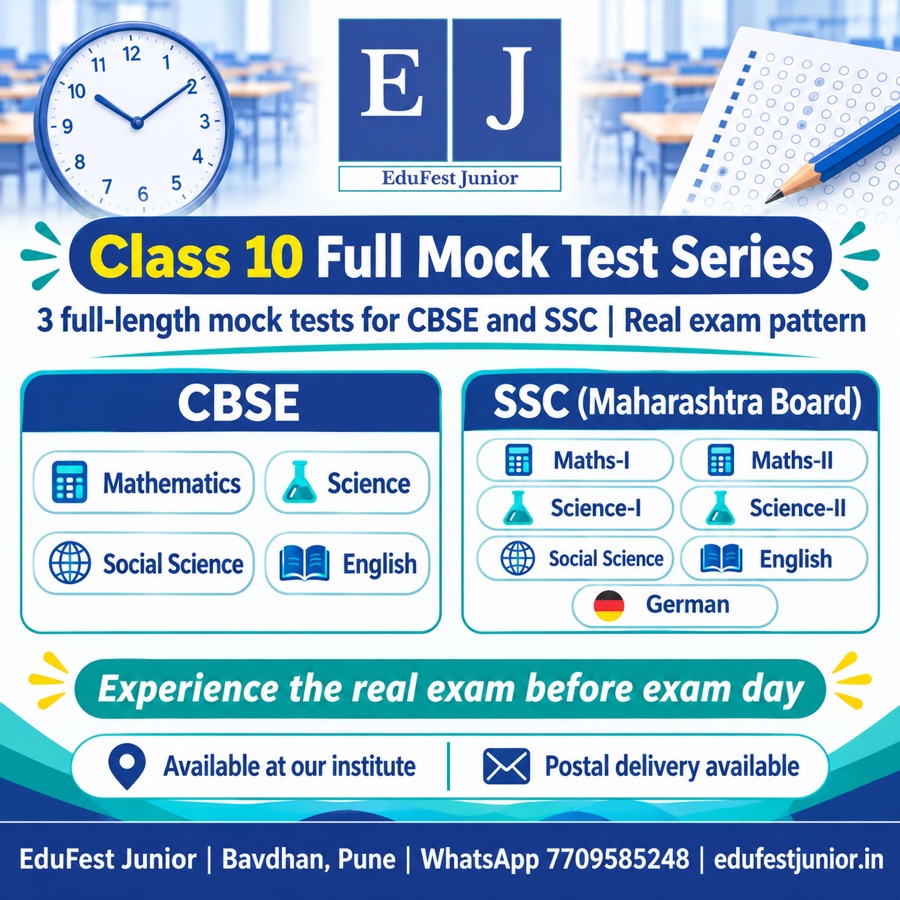
The Full Mock Test Series gives 3 full mock tests per board in real board paper pattern with an answer key, for Rs 4,000 per board. Take them at D-402 Dnyan Manjula, Bavdhan, or by postal delivery across India. WhatsApp 7709585248 or write to support@edufestacademy.in to enquire.
Frequently Asked Questions
Feel The Real Exam Before The Real Exam
Want to practise full papers like this under exam conditions? Share your name and number and we will WhatsApp you the Class 10 Test Series details.