A teacher's analysis of the CBSE Class 10 Science (086) sample paper 2026-27: the unchanged pattern, the Biology, Chemistry and Physics split, chapter-wise marks, the kinds of questions that carry the most marks, and a 4-week study plan for Board Exam 2027.
Feel The Real Exam Before The Real Exam
Share your name and number and we will WhatsApp you the details of the Class 10 Topic-Wise and Full Mock Test Series.
Quick Facts
| Paper | CBSE Class X Science (086) Sample Question Paper 2026-27, with marking scheme |
|---|---|
| Marks and time | 80 marks, 3 hours, 39 questions, all compulsory |
| Sections | A Biology (30), B Chemistry (25), C Physics (25) |
| Pattern change | None for 2026-27, as printed by CBSE |
| Source | Official CBSE sample paper and marking scheme, cbseacademic.nic.in |
| Enquire about the test series | WhatsApp 7709585248 or support@edufestacademy.in |
The Short Version
If you only have a minute: the Class 10 Science paper for 2026-27 has the same design as before. There are 39 questions for 80 marks in 3 hours. Section A is Biology, Section B is Chemistry and Section C is Physics. CBSE prints the line "There is no change in the Question Paper Design and Assessment Pattern for Academic Session 2026-27" on the paper.
What it means for you: the format is old but the questions are not memory questions. The paper asks you to read a situation (a food label, a graph of candles falling, a conversation between students, a door lock) and apply an idea. This article shows where the marks sit and how to prepare for that style.
The Paper Pattern
There is no single table of sections A to E in this paper. Instead it is divided by subject, and inside each subject the questions rise from 1 mark to 5 marks. The table below groups the 39 questions by marks.
| Type | Questions | Marks each | Total marks |
|---|---|---|---|
| MCQ and Assertion-Reason | Q1-Q9, Q17-Q24, Q30-Q32 (20 questions) | 1 | 20 |
| Very short answer | Q10, Q11, Q12, Q25, Q33, Q34 | 2 | 12 |
| Short answer | Q13, Q14, Q26, Q27, Q35, Q36, Q37 | 3 | 21 |
| Case-based | Q15, Q28, Q38 | 4 | 12 |
| Long answer | Q16, Q29, Q39 | 5 | 15 |
| Total | 39 questions | 80 |
Section-Wise Marks
Biology carries the most marks, and Chemistry and Physics are equal.
| Section / unit | Marks |
|---|---|
| Section A: Biology | 30 |
| Section B: Chemistry | 25 |
| Section C: Physics | 25 |
| Total | 80 |
Chapter-Wise Marks (Our Tagging)
We tagged each question to a chapter or skill and added up the marks. The list runs from the most marks to the least.
| Chapter / area | Questions | Marks | Share of paper |
|---|---|---|---|
| Life Processes | Q1, Q2, Q3, Q8, Q10, Q16 | 11 | 13.8% |
| Metals and Non-metals | Q23, Q27, Q28 | 8 | 10.0% |
| Chemical Reactions and Equations | Q17, Q22, Q29 | 7 | 8.8% |
| Carbon and its Compounds | Q19, Q21, Q25, Q26 | 7 | 8.8% |
| Light: Reflection and Refraction | Q30, Q32, Q33, Q35 | 7 | 8.8% |
| Magnetic Effects of Electric Current | Q36, Q38 | 7 | 8.8% |
| Electricity | Q31, Q34, Q37 | 6 | 7.5% |
| Control and Coordination | Q11, Q13 | 5 | 6.2% |
| How do Organisms Reproduce? | Q4, Q5, Q6, Q12 | 5 | 6.2% |
| Our Environment | Q7, Q9, Q14 | 5 | 6.2% |
| The Human Eye and the Colourful World | Q39 | 5 | 6.2% |
| Heredity | Q15 | 4 | 5.0% |
| Acids, Bases and Salts | Q18, Q20, Q24 | 3 | 3.8% |
| Total | 39 questions | 80 | 100% |
What The Numbers Tell Us
- Biology is 30 marks (37.5%). Life Processes alone is 11 marks, including the 5-mark question on hearts and breathing (Q16). Revise nutrition, respiration, transportation and excretion together.
- Genetics is only one question (Q15, 4 marks) but it is a full case study. Know how to work out the 3 : 1 and 9 : 3 : 3 : 1 ratios and write a reason.
- Chemistry is 25 marks. Metals and Non-metals (8) and Carbon and its Compounds (7) lead. Chemical Reactions has a 5-mark question (Q29) that asks you to correct equations and judge statements.
- Physics is 25 marks. Light (7) and Magnetic Effects (7) are the largest, then Electricity (6) and the Human Eye (5). Q35 and Q37 need numericals you can do by hand.
- Only 12 of the 80 marks are straightforward recall. The rest need you to explain, justify or judge.
- Every Physics numerical in this paper uses small whole numbers (24 cm, 1000 W, 250 V, 15 V). Practise doing them without a calculator.
How The Marks Are Really Given
- In Q10, Q14 and Q27 each part gets 1 mark (or ½ + ½). Write one clear point per part and do not mix them.
- In Q16 and Q39 the diagram carries marks. A neat, labelled diagram of 2 marks is the easiest part of a 5-mark question.
- In Q35 and Q37 the working is marked. Write the formula, then the numbers, then the answer with its unit.
- In Q29 you must name who is right and also give the reason. A bare name earns 1 mark out of 3.
A 4-Week Study Plan For Class 10 Science
This plan assumes about 1.5 to 2 hours of Science a day. Adjust the weeks to your own calendar, but keep the order: learn, practise questions, then take a timed paper.
- Week 1: Biology (30 marks). Day 1-2: Life Processes (nutrition, respiration, transportation, excretion). Draw the heart, the lungs and the nephron. Day 3: Control and Coordination (brain parts, reflex arc, plant hormones). Day 4: Reproduction (flower, human system, contraception). Day 5: Heredity (Mendel's crosses, sex determination). Day 6: Our Environment (food chains, the 10% law, ozone). Day 7: solve all Biology questions of this sample paper.
- Week 2: Chemistry (25 marks). Day 1-2: Chemical Reactions and Equations (balancing, types of reactions, redox, rancidity, corrosion). Day 3: Acids, Bases and Salts (pH, indicators, chlor-alkali, salts with water of crystallisation). Day 4: Metals and Non-metals (reactivity series, properties, corrosion). Day 5-6: Carbon and its Compounds (bonding, homologous series, ethanol and ethanoic acid, soaps). Day 7: solve all Chemistry questions of the sample paper.
- Week 3: Physics (25 marks). Day 1-2: Light (ray diagrams, lens and mirror formula, refraction). Day 3: Human Eye and Colourful World (defects and corrections, dispersion, scattering). Day 4-5: Electricity (Ohm's law, series and parallel, power, Joule's heating). Day 6: Magnetic Effects (right-hand thumb rule, solenoid, Fleming's rule, motor, generator). Day 7: solve all Physics questions of the sample paper.
- Week 4: Practice and polish. Take the full sample paper in 3 hours without notes. Mark it with the official marking scheme. List every lost mark by chapter and by cause (concept, careless, did not read, did not write the reason). Revise the weakest two chapters, then take a second timed paper.
- Every day: a 20-minute habit. Take one competency-style question (a graph, a dialogue or a case) and write the full answer, with a reason. Check it against the marking scheme.
Step-By-Step Solutions To The Full Paper
We have solved the complete paper, in the order of the paper, and matched the answers to the official marking scheme. Try the paper yourself first, then use the solutions.
Where This Paper Comes From
Everything here is based on the Sample Question Paper and Marking Scheme for Class X (2026-27), Science (086), published by the Central Board of Secondary Education on cbseacademic.nic.in. Marks and the paper design are as printed by CBSE.
The tagging of each question to a chapter or skill is our own reading as teachers. Some questions use ideas from more than one chapter, so another teacher may tag one or two questions differently.
Ready To Try A Full Paper Under Exam Conditions?
Reading a solution is not the same as writing the paper in the exam hall. Use chapter-wise tests to find your weak chapter, then full mock tests in the real board pattern.
Two Class 10 Test Series At EduFest, Bavdhan, Pune
EduFest Junior Academy runs two separate series for Board Exam 2027, both starting 1 Dec 2026, for CBSE and Maharashtra State Board (SSC) students.
The Topic-Wise Test Series gives 10 chapter-wise Mathematics tests per board (Science is coming soon), with concept clarity first, real board-pattern papers, a separate answer key and chapter-wise weak-area diagnosis. Price is available on WhatsApp.
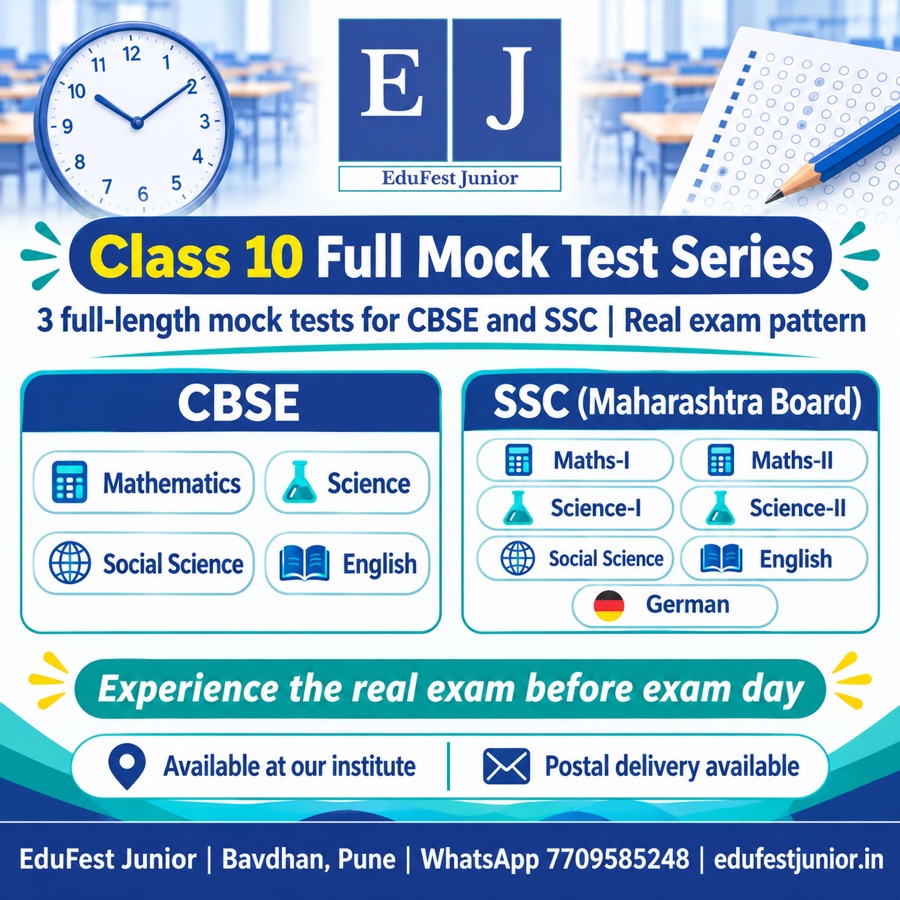
The Full Mock Test Series gives 3 full mock tests per board in real board paper pattern with an answer key, for Rs 4,000 per board. Take them at D-402 Dnyan Manjula, Bavdhan, or by postal delivery across India. WhatsApp 7709585248 or write to support@edufestacademy.in to enquire.
Frequently Asked Questions
Feel The Real Exam Before The Real Exam
Share your name and number and we will WhatsApp you the details of the Class 10 Topic-Wise and Full Mock Test Series.