A teacher's analysis of the CBSE Class 10 Social Science (087) sample paper 2026-27: the unchanged pattern, the 20-20-20-20 split across History, Geography, Political Science and Economics, chapter-wise marks, map work, and a 4-week study plan for Board Exam 2027.
Feel The Real Exam Before The Real Exam
Share your name and number and we will WhatsApp you the details of the Class 10 Topic-Wise and Full Mock Test Series.
Quick Facts
| Paper | CBSE Class X Social Science (087) Sample Question Paper 2026-27, with marking scheme |
|---|---|
| Marks and time | 80 marks, 3 hours, 38 questions, all compulsory |
| Sections | A History, B Geography, C Political Science, D Economics, 20 marks each |
| Map work | 5 marks (Q9 for 2, Q19 for 3) |
| Source | Official CBSE sample paper and marking scheme, cbseacademic.nic.in |
| Enquire about the test series | WhatsApp 7709585248 or support@edufestacademy.in |
The Short Version
If you only have a minute: the Class 10 Social Science paper for 2026-27 has the same design as before. There are 38 questions for 80 marks in 3 hours, split equally across History, Geography, Political Science and Economics at 20 marks each. CBSE prints "There is no change in the Question Paper Design and Assessment Pattern for Academic Session 2026-27" on the paper.
What it means for you: the format is old, but many questions are competency-based. They ask you to analyse a statement, read a table, judge who is right, or suggest a solution, and then support the answer with points from the NCERT book. This article shows where the marks sit and how to prepare.
The Paper Pattern
The paper is divided by subject, with the same question types in every section. The table groups the 38 questions by type.
| Type | Questions | Marks each | Total marks |
|---|---|---|---|
| Multiple choice and Assertion-Reason | Q1-Q4, Q10-Q15, Q20-Q23, Q29-Q34 (20 questions) | 1 | 20 |
| Very short answer (about 40 words) | Q5, Q16, Q24, Q25 | 2 | 8 |
| Short answer (about 60 words) | Q6, Q26, Q35, Q36, Q37 | 3 | 15 |
| Long answer (about 120 words) | Q7, Q17, Q27, Q38 | 5 | 20 |
| Case-based (about 100 words) | Q8, Q18, Q28 | 4 | 12 |
| Map skill-based | Q9 (History), Q19 (Geography) | 2 and 3 | 5 |
| Total | 38 questions | 80 |
Section-Wise Marks
Each subject carries exactly the same marks, so every subject deserves the same weight in your preparation.
| Section / unit | Marks |
|---|---|
| Section A: History | 20 |
| Section B: Geography | 20 |
| Section C: Political Science | 20 |
| Section D: Economics | 20 |
| Total | 80 |
Chapter-Wise Marks (Our Tagging)
We tagged each question to a chapter or skill and added up the marks. The list runs from the most marks to the least.
| Chapter / area | Questions | Marks | Share of paper |
|---|---|---|---|
| History: Nationalism in India | Q2, Q7, Q9 | 8 | 10.0% |
| Economics: Development | Q29, Q38 | 6 | 7.5% |
| History: Print Culture and the Modern World | Q4, Q8 | 5 | 6.2% |
| Geography: Agriculture | Q17 | 5 | 6.2% |
| Political Science: Political Parties | Q22, Q28 | 5 | 6.2% |
| Political Science: Federalism | Q27 | 5 | 6.2% |
| Economics: Sectors of the Indian Economy | Q30, Q31, Q35 | 5 | 6.2% |
| Economics: Money and Credit | Q32, Q33, Q36 | 5 | 6.2% |
| History: The Rise of Nationalism in Europe | Q1, Q6 | 4 | 5.0% |
| Geography: Forest and Wildlife Resources | Q18 | 4 | 5.0% |
| Geography: Manufacturing Industries | Q14, Q15, Q19(II) | 4 | 5.0% |
| Political Science: Power Sharing | Q20, Q21, Q24 | 4 | 5.0% |
| Economics: Globalisation and the Indian Economy | Q34, Q37 | 4 | 5.0% |
| History: The Making of a Global World | Q3, Q5 | 3 | 3.8% |
| Geography: Water Resources | Q16, Q19(I) | 3 | 3.8% |
| Political Science: Outcomes of Democracy | Q23, Q25 | 3 | 3.8% |
| Political Science: Gender, Religion and Caste | Q26 | 3 | 3.8% |
| Geography: Resources and Development | Q10, Q11 | 2 | 2.5% |
| Geography: Minerals and Energy Resources | Q12, Q13 | 2 | 2.5% |
| Total | 38 questions | 80 | 100% |
What The Numbers Tell Us
- The four sections are equal at 20 marks each. A student who neglects one subject, such as Economics, gives up a quarter of the paper.
- In History, Nationalism in India alone is 8 marks (Q2, Q7, Q9). The 5-mark question on the Non-Cooperation Movement or Civil Disobedience Movement is almost certain, so know both with their dates and effects.
- In Geography, Agriculture has the single 5-mark question (Q17), and Q18 on forest conservation is a case study. Learn crop conditions in a table: tea and coffee, rice and wheat, cotton and jute.
- In Political Science, Power Sharing and Political Parties lead. Q27 on federalism or the 1992 amendments is the 5-mark question, so know both lists of five points.
- In Economics, the 5-mark Q38 is a data table about development. Read the numbers, compare, and give two inferences and two suggestions.
- Map work is 5 marks. Make a list of every place in the NCERT map work, mark them yourself on a blank map, and check against the book.
How The Marks Are Really Given
- Most written answers are marked per point (one mark per point, or 1 + 2 + 1 for case studies). Write separate numbered points and do not write long paragraphs.
- 'Any 2' or 'any 3' appears in the marking scheme. Write exactly that many strong points rather than many weak ones.
- Q38 gives 1 mark for the comparison, 2 for the inferences and 2 for the suggestions. Make sure all three parts are present.
- For map questions, write the name on the line and mark the spot neatly. For visually impaired candidates only the names are needed.
A 4-Week Study Plan For Class 10 Social Science
This plan assumes about 1.5 to 2 hours of Social Science a day. Each week covers one or two subjects. Keep the order, and always finish a week with questions from the sample paper.
- Week 1: History (20 marks). Day 1-2: Nationalism in Europe (Mazzini, Vienna 1815, Greek war, allegories). Day 3-4: Nationalism in India (Rowlatt, Jallianwala Bagh, Non-Cooperation, Civil Disobedience, Salt March). Day 5: Making of a Global World (silk routes, Great Depression). Day 6: Print Culture. Day 7: solve all History questions of the sample paper and do the History map places.
- Week 2: Geography (20 marks). Day 1: Resources and Development (types of resources, soil). Day 2: Forest and Wildlife. Day 3: Water Resources (dams, rainwater harvesting). Day 4: Agriculture (crops table). Day 5: Minerals and Energy. Day 6: Manufacturing Industries. Day 7: solve all Geography questions and practise the Geography map list.
- Week 3: Political Science and Economics (40 marks). Day 1-2: Power Sharing and Federalism. Day 3: Gender, Religion and Caste, and Political Parties. Day 4: Outcomes of Democracy. Day 5: Development and Sectors of the Indian Economy. Day 6: Money and Credit, and Globalisation. Day 7: solve all Political Science and Economics questions.
- Week 4: Practice and polish. Write the full sample paper in 3 hours, keeping to the word limits. Mark it with the official scheme and list the marks lost by chapter. Revise the weakest two chapters, redo all map places, and take a second timed paper.
- Every day: a 15-minute habit. Take one 3-mark or 5-mark question, write the answer in numbered points, and check it against the NCERT text. Do one map question as well.
Step-By-Step Solutions To The Full Paper
We have solved the complete paper, in the order of the paper, and matched the answers to the official marking scheme. Try the paper yourself first, then use the solutions.
Where This Paper Comes From
Everything here is based on the Sample Question Paper and Marking Scheme for Class X (2026-27), Social Science (087), published by the Central Board of Secondary Education on cbseacademic.nic.in. Marks and the paper design are as printed by CBSE.
The tagging of each question to a chapter or skill is our own reading as teachers. Some questions use ideas from more than one chapter, so another teacher may tag one or two questions differently.
Ready To Try A Full Paper Under Exam Conditions?
Reading a solution is not the same as writing the paper in the exam hall. Use chapter-wise tests to find your weak chapter, then full mock tests in the real board pattern.
Two Class 10 Test Series At EduFest, Bavdhan, Pune
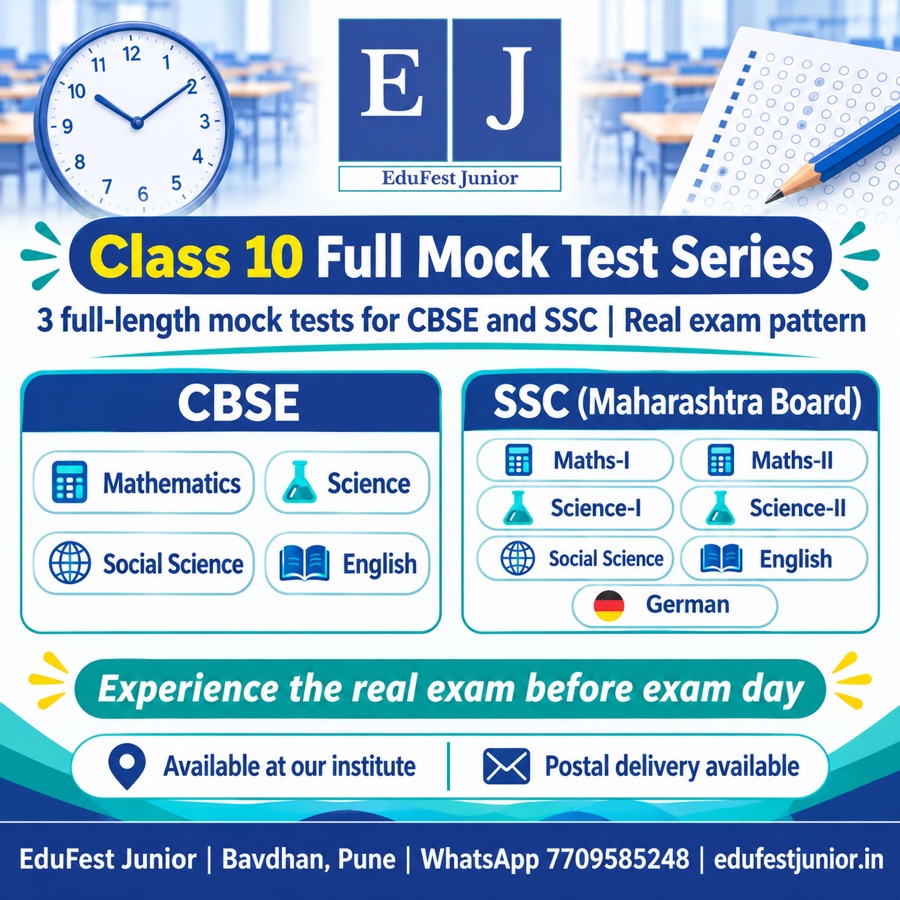
EduFest Junior Academy runs two separate series for Board Exam 2027, both starting 1 Dec 2026, for CBSE and Maharashtra State Board (SSC) students.
The Topic-Wise Test Series gives 10 chapter-wise Mathematics tests per board (Science is coming soon), with concept clarity first, real board-pattern papers, a separate answer key and chapter-wise weak-area diagnosis. Price is available on WhatsApp.
The Full Mock Test Series gives 3 full mock tests per board in real board paper pattern with an answer key, for Rs 4,000 per board. Take them at D-402 Dnyan Manjula, Bavdhan, or by postal delivery across India. WhatsApp 7709585248 or write to support@edufestacademy.in to enquire.
Frequently Asked Questions
Feel The Real Exam Before The Real Exam
Share your name and number and we will WhatsApp you the details of the Class 10 Topic-Wise and Full Mock Test Series.