Chapter 12 Exercise 12.3 Question 1 Solution : P, Q, R are the midpoints of sides AB, AC, BC of ∆ABC. (i) Show that ∆PQR is congruent to ∆QPA and to two other triangles which you should identify. (ii) If ∆ABC is erased, leaving only ∆PQR, can you reconstruct ∆ABC?
Answer: ∆PQR ≅ ∆QPA, ∆RBP, ∆CRQ; yes
The figure
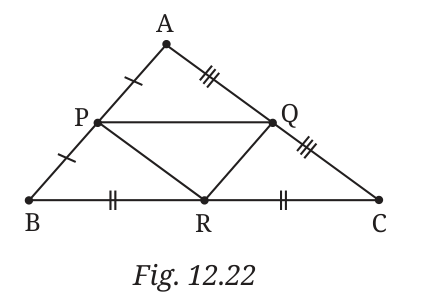
Part (i) · Using the Midpoint Theorem three times
By the Midpoint Theorem, each segment joining midpoints is half of the third side:
PQ = BC2, QR = AB2, RP = AC2
Also AP = PB = AB2, AQ = QC = AC2, BR = RC = BC2. So QR = AP, RP = AQ, PQ = BR = RC.
| Triangle | Its three sides | Same as ∆PQR? |
|---|---|---|
| ∆PQR | PQ = BC/2, QR = AB/2, RP = AC/2 | — |
| ∆QPA | QP = BC/2, PA = AB/2, AQ = AC/2 | yes, by SSS |
| ∆RBP | RB = BC/2, BP = AB/2, PR = AC/2 | yes, by SSS |
| ∆CRQ | CR = BC/2, RQ = AB/2, QC = AC/2 | yes, by SSS |
So ∆PQR ≅ ∆QPA ≅ ∆RBP ≅ ∆CRQ. The four small triangles cut ∆ABC into four congruent parts.
Part (ii) · Reconstructing ∆ABC
Yes. AB passes through P and is parallel to QR (since PQ and QR are halves of BC and AB with PQ ∥ BC and QR ∥ AB). Likewise BC passes through R parallel to PQ, and CA passes through Q parallel to PR.
- Through P draw a line parallel to QR.
- Through Q draw a line parallel to RP.
- Through R draw a line parallel to PQ.
- The three lines form a triangle, which is ∆ABC, with P, Q, R as the midpoints of its sides.
(i) ∆PQR ≅ ∆QPA, ∆PQR ≅ ∆RBP and ∆PQR ≅ ∆CRQ. (ii) Yes: through each vertex of ∆PQR draw a line parallel to the opposite side.