IGKO is TODAY!
Mock Test ₹150 View Schedule

Ganita Manjari · Class 9 · Part II · Chapter 13

Ganita Manjari Class 9 Maths Chapter 13 Two Variables, One Line Exercise 13.5 Solutions

Nine questions on solving pairs of linear equations: ten word problems, a graph, ratio tests, a garden, Mahāvīra's citrons, pencils and pens, and a stool.

Last updated 6 October 2026

  • 9Questions
  • 2Diagrams
  • Ch 13Two Variables, One Line

How to answer every question

  1. Name the unknowns Let x and y stand for the quantities asked.
  2. Form two equations One equation for each fact in the problem.
  3. Solve Use substitution or elimination, or add and subtract when the pair is special.
  4. Check in the problem Put the answers back into the story, not just the equations.

Substitution: write one variable in terms of the other, then put it in the other equation.

Elimination: make the coefficients of one variable equal and add or subtract.

Nature of the pair: a₁a₂ ≠ b₁b₂ one solution; all three ratios equal, infinitely many; first two equal and third different, none.

Word problems

Chapter 13 Exercise 13.5 Question 1 Solution : Form a pair of linear equations for each problem and find the solution.

Answer: ten solutions
(i) Sum 5, difference −21Answer: −8 and 13

Let the numbers be x and y.

x + y = 5, x − y = −21

Add the two equations: 2x = −16, so x = −8. Then y = 5 − (−8) = 13.

Check: −8 + 13 = 5 ✓ and −8 − 13 = −21 ✓.

(ii) Difference 26, one is three times the otherAnswer: 13 and 39

Let the larger number be x and the smaller y.

x − y = 26, x = 3y

Substitute: 3y − y = 26, so y = 13 and x = 39.

Check: 39 − 13 = 26 ✓ and 39 = 3 × 13 ✓. If negative numbers are allowed, (−13, −39) also works: −13 − (−39) = 26 and −39 = 3(−13). For natural numbers the answer is 13 and 39.

(iii) Bats and ballsAnswer: bat ₹1200, ball ₹80

Let a bat cost ₹b and a ball ₹c.

7b + 6c = 8880, 3b + 5c = 4000

Multiply the first by 3 and the second by 7 to make the b-coefficients equal:

21b + 18c = 26640, 21b + 35c = 28000

Subtract: 17c = 1360, so c = 80. Then 3b = 4000 − 400 = 3600, so b = 1200.

Check: 7 × 1200 + 6 × 80 = 8400 + 480 = 8880 ✓.

(iv) Taxi chargesAnswer: ₹25 fixed, ₹13 per km, ₹350 for 25 km

Let the fixed charge be ₹x and the charge per km ₹y.

x + 10y = 155, x + 15y = 220

Subtract: 5y = 65, so y = 13. Then x = 155 − 130 = 25.

fare for 25 km = 25 + 25 × 13 = 25 + 325 = 350

Check: 25 + 15 × 13 = 220 ✓.

(v) The fraction with 9/11 and 5/6Answer: 7/9

Let the fraction be nd.

n + 2d + 2 = 911, n + 3d + 3 = 56

Cross-multiply: 11(n + 2) = 9(d + 2), so 11n − 9d = −4. And 6(n + 3) = 5(d + 3), so 6n − 5d = −3.

Multiply the first by 5 and the second by 9: 55n − 45d = −20 and 54n − 45d = −27. Subtract: n = 7. Then 77 − 9d = −4, so d = 9.

Check: 911 ✓ and 1012 = 56 ✓.

(vi) Adding 1 and subtracting 1Answer: 3/5

Let the fraction be nd.

n + 1d − 1 = 1, nd + 1 = 12

The first gives n + 1 = d − 1, so d = n + 2. The second gives 2n = d + 1 = n + 3, so n = 3 and d = 5.

Check: 44 = 1 ✓ and 36 = 12 ✓.

(vii) Nuri and SonuAnswer: Nuri 50, Sonu 20

Let Nuri be N years old and Sonu S.

N − 5 = 3(S − 5), N + 10 = 2(S + 10)

These are N − 3S = −10 and N − 2S = 10. Subtract the first from the second: S = 20. Then N = 50.

Check: five years ago 45 and 15 (45 = 3 × 15 ✓); in ten years 60 and 30 (60 = 2 × 30 ✓).

(viii) Two-digit numberAnswer: 18

Let the tens digit be x and the units digit y. The number is 10x + y.

x + y = 9, 9(10x + y) = 2(10y + x)

The second gives 90x + 9y = 20y + 2x, so 88x = 11y, so y = 8x. Then x + 8x = 9, so x = 1 and y = 8.

Check: 9 × 18 = 162 and 2 × 81 = 162 ✓.

(ix) ₹50 and ₹100 notesAnswer: 10 notes of ₹50, 15 notes of ₹100

Let there be x notes of ₹50 and y notes of ₹100.

x + y = 25, 50x + 100y = 2000

Divide the second by 50: x + 2y = 40. Subtract the first: y = 15. Then x = 10.

Check: 500 + 1500 = 2000 ✓.

(x) Library chargesAnswer: ₹15 fixed, ₹3 per extra day

Let the fixed charge for the first 3 days be ₹F and the charge per extra day ₹e.

F + 4e = 27 (7 days), F + 2e = 21 (5 days)

Subtract: 2e = 6, so e = 3. Then F = 21 − 6 = 15.

Check: 15 + 4 × 3 = 27 ✓.

(i) −8, 13; (ii) 13, 39; (iii) bat ₹1200, ball ₹80; (iv) ₹25, ₹13 per km, ₹350 for 25 km; (v) 79; (vi) 35; (vii) 50 and 20; (viii) 18; (ix) 10 and 15 notes; (x) ₹15 and ₹3.
Chapter 13 Exercise 13.5 Question 2 Solution : 10 Grade 9 students took part in a quiz. The number of girls is 4 more than the number of boys. Form a pair of equations and find the number of boys and girls graphically.

Answer: 3 boys and 7 girls
The equations

Let x be the number of boys and y the number of girls.

x + y = 10, y = x + 4
Tables and graph
x + y = 10y = x + 4
x010x07
y100y411
Graph of x + y = 10 and y = x + 4The two lines meet at the point (3, 7): 3 boys and 7 girls.Q2 · the lines meet at (3, 7)12345678910111234567891011boys (x)girls (y)x + y = 10y = x + 4(3, 7)
Q2 · the two lines meet at (3, 7)
Reading the graph, and a check

The lines meet at (3, 7), so there are 3 boys and 7 girls. Check: 3 + 7 = 10 ✓ and 7 = 3 + 4 ✓.

There are 3 boys and 7 girls.

Nature of solutions

Chapter 13 Exercise 13.5 Question 3 Solution : Use the ratios a₁a₂, b₁b₂, c₁c₂ to decide if the lines intersect, are parallel or are coincident: (i) 5x − 4y + 8 = 0 and 7x + 6y − 9 = 0; (ii) 9x + 3y + 12 = 0 and 18x + 6y + 24 = 0; (iii) 6x − 3y + 10 = 0 and 2x − y + 9 = 0.

Answer: intersect, coincident, parallel
The ratios
Paira₁/a₂b₁/b₂c₁/c₂Conclusion
(i)5/7−4/6 = −2/38/(−9) = −8/9a₁/a₂ ≠ b₁/b₂: the lines intersect at one point
(ii)9/18 = 1/23/6 = 1/212/24 = 1/2all equal: the lines are coincident
(iii)6/2 = 3−3/−1 = 310/9a₁/a₂ = b₁/b₂ ≠ c₁/c₂: the lines are parallel

(i) Intersect, (ii) coincident, (iii) parallel.

Chapter 13 Exercise 13.5 Question 4 Solution : Which pairs have solutions? Find them graphically if they exist. (i) x + y = 5, 2x + 2y = 10 (ii) x − y = 8, 3x − 3y = 16 (iii) 2x + y − 6 = 0, 4x − 2y − 4 = 0 (iv) 2x − 2y − 2 = 0, 4x − 4y − 5 = 0

Answer: (i) infinite; (ii) none; (iii) (2, 2); (iv) none
Check with the ratios first
Paira₁/a₂b₁/b₂c₁/c₂Nature
(i)1/21/2−5/−10 = 1/2coincident: infinitely many solutions
(ii)1/3−1/−3 = 1/3−8/−16 = 1/2parallel: no solution
(iii)2/4 = 1/21/(−2) = −1/2−6/−4a₁/a₂ ≠ b₁/b₂: one solution
(iv)2/4 = 1/2−2/−4 = 1/2−2/−5 = 2/5parallel: no solution
Solutions graphically
Graphs for Exercise 13.5 Q4 (i) and (iii)Left: the lines x+y=5 and 2x+2y=10 are the same line. Right: 2x+y-6=0 and 4x-2y-4=0 meet at (2, 2).Q4 · graphical solutions of (i) and (iii)12345671234567xyx + y = 5 and 2x + 2y = 10(i) the two lines coincide-112345-11234567xy2x + y − 6 = 04x − 2y − 4 = 0(2, 2)(iii) the lines meet at (2, 2)
Q4 · (i) coincident lines and (iii) lines meeting at (2, 2)

(i) Both equations give the same line, so every point on x + y = 5 is a solution, for example (0, 5), (2, 3), (5, 0). (iii) The lines meet at (2, 2): check 4 + 2 − 6 = 0 ✓ and 8 − 4 − 4 = 0 ✓.

(i) Infinitely many (every point of x + y = 5). (ii) No solution. (iii) (2, 2). (iv) No solution.

Word problems

Chapter 13 Exercise 13.5 Question 5 Solution : Half the perimeter of a rectangular garden, whose length is 4 m more than its width, is 36 m. Find its dimensions.

Answer: 16 m by 20 m
Equations

Let the width be w and the length l.

l = w + 4, l + w = 36

Substitute: w + 4 + w = 36, so 2w = 32, so w = 16 and l = 20.

Check

20 − 16 = 4 ✓ and half the perimeter is 20 + 16 = 36 ✓.

The garden is 20 m long and 16 m wide.

Nature of solutions

Chapter 13 Exercise 13.5 Question 6 Solution : Given 2x + 3y − 8 = 0, write another linear equation so that the pair represents (i) intersecting lines, (ii) parallel lines, (iii) coincident lines.

Answer: examples for each case
Use the ratios with a₁ = 2, b₁ = 3, c₁ = −8
CaseConditionExample
(i) intersectinga₁/a₂ ≠ b₁/b₂x − y − 1 = 0: 21 ≠ 3−1
(ii) parallela₁/a₂ = b₁/b₂ ≠ c₁/c₂4x + 6y − 9 = 0: 24 = 36 = 12, but −8−9 ≠ 12
(iii) coincidenta₁/a₂ = b₁/b₂ = c₁/c₂4x + 6y − 16 = 0: all ratios 12

Many answers are possible; each works if the ratios behave as in the condition.

(i) x − y − 1 = 0, (ii) 4x + 6y − 9 = 0, (iii) 4x + 6y − 16 = 0.

Word problems

Chapter 13 Exercise 13.5 Question 7 Solution : (Mahāvīrāchārya, c. 850 CE) 9 citrons and 7 fragrant wood-apples together cost 107, and 7 citrons and 9 wood-apples together cost 101. Find the price of each.

Answer: citron 8, wood-apple 5
The special pair
9x + 7y = 107, 7x + 9y = 101

The coefficients of x and y are swapped between the two equations. So adding or subtracting makes the work easy.

Add and subtract
  1. Add: 16x + 16y = 208, so x + y = 13.
  2. Subtract (first minus second): 2x − 2y = 6, so x − y = 3.

Adding these two results gives 2x = 16, so x = 8, and then y = 5.

Check

9 × 8 + 7 × 5 = 72 + 35 = 107 ✓ and 7 × 8 + 9 × 5 = 56 + 45 = 101 ✓.

A citron costs 8 and a wood-apple costs 5.

Chapter 13 Exercise 13.5 Question 8 Solution : 5 pencils and 7 pens cost ₹50, and 7 pencils and 5 pens cost ₹46. Find the cost of each pencil and pen.

Answer: pencil ₹3, pen ₹5
Same trick
5p + 7q = 50, 7p + 5q = 46
  1. Add: 12p + 12q = 96, so p + q = 8.
  2. Subtract (second minus first): 2p − 2q = −4, so p − q = −2.

Adding: 2p = 6, so p = 3, and then q = 5.

Check

5 × 3 + 7 × 5 = 15 + 35 = 50 ✓ and 7 × 3 + 5 × 5 = 21 + 25 = 46 ✓.

A pencil costs ₹3 and a pen costs ₹5.

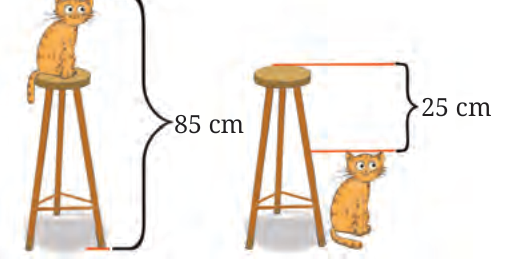
Chapter 13 Exercise 13.5 Question 9 Solution : Find the height of the stool.

Answer: 55 cm
The picture
Left: a cat sitting on a stool, with the total height from the floor to the top of the cat marked 85 cm. Right: the cat sitting on the floor next to the stool, with the top of the stool 25 cm above the cat's head.
Q9 · the cat on the stool and beside the stool (from the book)
Two equations

Let the stool be h cm tall and the cat c cm tall.

  • Cat on the stool: the height from the floor is h + c = 85.
  • Cat on the floor: the stool top is 25 cm above the cat's head, so h − c = 25.

Add the equations: 2h = 110, so h = 55. Then c = 30.

Check

55 + 30 = 85 ✓ and 55 − 30 = 25 ✓.

The stool is 55 cm high (and the cat is 30 cm).

Answers at a glance

Check every answer in the story, not only in the equations.

QuestionWhat is askedKey ideaAnswer
Q1 Ten word problemsForm and solveSee the steps
Q2 Boys and girlsGraph of x + y = 10, y = x + 43 boys, 7 girls
Q3 Nature of three pairsRatiosIntersect, coincident, parallel
Q4 Which pairs have solutionsRatios and graphInfinite; none; (2, 2); none
Q5 Gardenl = w + 4, l + w = 3616 m by 20 m
Q6 Second equationRatio rulesExamples for all three
Q7 Citrons and wood-applesAdd and subtract8 and 5
Q8 Pencils and pensAdd and subtract₹3 and ₹5
Q9 Stoolh + c = 85, h − c = 2555 cm

Source of the questions: NCERT, Ganita Manjari, Grade 9, Part II, Chapter 13, Exercise Set 13.5. The solutions, explanations and diagrams on this page are our own working.

Call WhatsApp Book Demo