Chapter 14 Exercise 14.4 Question 1 Solution : A ball bearing has radius 0.7 cm. Find its surface area.
Solution:
r = 0.7 cm
Surface area of a sphere = 4πr2
∴ SA = 4 × 227 × 0.7 × 0.7
∴ SA = 887 × 0.49 = 6.16 cm2
The surface area is 6.16 cm².
Ganita Manjari · Class 9 · Part II · Chapter 14
Eight questions on spheres and hemispheres: surface areas, spheres of one metal, packing, percentage changes and the cost of painting a dome.
Brilliant! You have finished every question in this exercise. Subscribe for the next chapter
Sphere: all points at a given distance r from the centre.
Hemisphere: half a sphere; its flat circle is the base.
Same metal: equal density, so weight is proportional to volume.
Solution:
r = 0.7 cm
Surface area of a sphere = 4πr2
∴ SA = 4 × 227 × 0.7 × 0.7
∴ SA = 887 × 0.49 = 6.16 cm2
The surface area is 6.16 cm².
Solution:
The spheres are of the same metal, so weight is proportional to volume.
5920740 = 8 = VlargeVsmall = (Rr)3
∴ Rr = ∛8 = 2
Diameter of the smaller sphere = 5 cm, so r = 52 = 2.5 cm
∴ R = 2 × 2.5 = 5 cm
The larger sphere has radius 5 cm.
Solution:
Let the radius of the earth be R. The radius of the moon is R4.
Surface area ∝ (radius)2
∴ SA of moonSA of earth = 4π(R/4)24πR2 = 116
∴ Moon : Earth = 1 : 16
The surface areas are in the ratio 1 : 16.
Solution:
r = 21 cm
(i) CSA = 2πr2 = 2 × 227 × 21 × 21
∴ CSA = 2772 cm2
(ii) TSA = 3πr2 = 3 × 227 × 441
∴ TSA = 4158 cm2
(i) 2772 cm², (ii) 4158 cm².
Solution:
Volume of box = 16 × 8 × 8 = 1024 cm3
Volume of one sphere = 43π × 23 = 32π3 ≈ 33.51 cm3
Volume of 16 spheres = 16 × 32π3 = 512π3 ≈ 536.17 cm3
Volume of liquid = 1024 − 536.17 = 487.83
∴ Volume of liquid ≈ 488 cm3
(The 16 spheres fit exactly: 4 along the length, and 2 across and 2 up.)
The liquid has volume about 488 cm³.
Solution:
Let the radius be r. New radius = 1.1r
New volume = 43π(1.1r)3 = 1.331 × 43πr3
∴ Increase = 1.331 − 1 = 0.331
∴ The volume increases by 33.1%.
The volume increases by 33.1%.
Solution:
Let the radius be r. New radius = r(1 + x100).
New volume = 1.728 × old volume, because 100% + 72.8% = 172.8%.
∴ (1 + x100)3 = 1.728
Since 1.23 = 1.728, we get 1 + x100 = 1.2
∴ x100 = 0.2, so x = 20
Check: 1.2 × 1.2 = 1.44 and 1.44 × 1.2 = 1.728 ✓
x = 20: the radius increases by 20%.

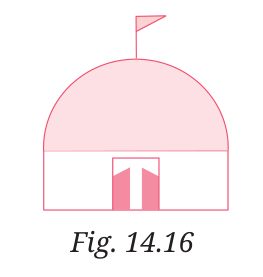
Solution:
Circumference of the base = 2πr = 35.2 m
∴ r = 35.2 × 72 × 22 = 246.444 = 5.6 m
Only the curved surface of the dome is painted.
CSA = 2πr2 = 2 × 227 × 5.6 × 5.6
∴ CSA = 197.12 m2
1 m2 = 10,000 cm2, so area = 197.12 × 10,000 = 1971200 cm2
Cost = 1971200100 × 10 = 19712 × 10
∴ Cost = ₹ 1,97,120
The painting costs ₹1,97,120.
Surface areas scale with r squared and volumes with r cubed.
| Question | What is asked | Key idea | Answer |
|---|---|---|---|
| Q1 | Ball bearing | 4πr² | 6.16 cm² |
| Q2 | Spheres of one metal | Weight ∝ volume | 5 cm |
| Q3 | Moon and Earth | Area ∝ r² | 1 : 16 |
| Q4 | Hemisphere r = 21 | 2πr², 3πr² | 2772; 4158 cm² |
| Q5 | Spheres in a box | 1024 − 536.17 | 488 cm³ |
| Q6 | Radius +10% | 1.1³ | 33.1% |
| Q7 | Volume +72.8% | 1.2³ = 1.728 | x = 20 |
| Q8 | Dome painting | 2πr², r = 5.6 | ₹1,97,120 |
Source of the questions: NCERT, Ganita Manjari, Grade 9, Part II, Chapter 14, Exercise Set 14.4. The solutions, explanations and diagrams on this page are our own working.