IGKO is TODAY!
Mock Test ₹150 View Schedule

Ganita Manjari · Class 9 · Part II · Chapter 13

Ganita Manjari Class 9 Maths Chapter 13 Two Variables, One Line End-of-Chapter Exercises Solutions

All 16 end-of-chapter questions on lines and pairs of equations: the line y = 3x, temperature conversion, mobile plans, robots, ages and a train.

Last updated 6 October 2026

  • 16Questions
  • 3Diagrams
  • Ch 13Two Variables, One Line

How to answer every question

  1. Read the graph or the equation Find two points on each line.
  2. Use the slope m = rise over run, and y = mx + d gives the intercepts.
  3. Solve the pair Graph, substitution or elimination.
  4. Check in the story Put the answer back into the problem.

y-intercept: the point where the line meets the y-axis.

x-intercept: the point where the line meets the x-axis, y = 0.

Coincident lines: the same line; infinitely many solutions.

Lines and slope

Chapter 13 End-of-Chapter Exercises Question 1 Solution : The graph of y = 3x passes through (0, 0) and (2, 6). (i) Find the slope. (ii) Find the y-intercept and its meaning. (iii) A tank is filled so that the water level y (cm) after x minutes follows this graph: (a) the height after 5 minutes; (b) the time to reach 21 cm. (iv) Does (4, 10) lie on the line? (v) Plot where the line meets x = 3.

Answer: slope 3; 15 cm; 7 min; no; (3, 9)
The graph
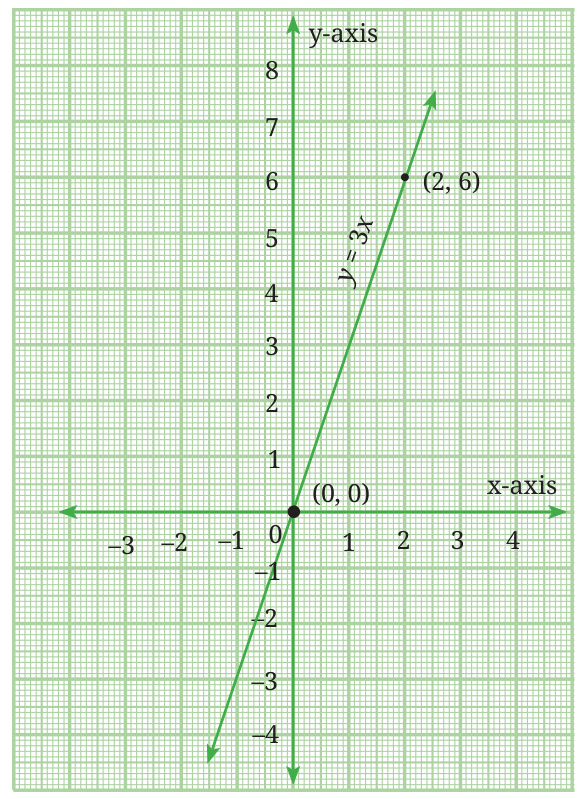
Graph of the line y = 3x passing through (0, 0) and (2, 6) on a grid.
Q1 · the line y = 3x (from the book)
Part (i) · Slope
slope = 6 − 02 − 0 = 62 = 3

We take the two points (0, 0) and (2, 6): the rise is 6 and the run is 2.

Part (ii) · y-intercept

The line crosses the y-axis at (0, 0), so the y-intercept is 0. For the tank, the water level is 0 cm at time 0: the tank starts empty.

Part (iii) · The water level
  • After 5 minutes: y = 3 × 5 = 15 cm.
  • For 21 cm: 21 = 3x, so x = 7 minutes.
Part (iv) · Is (4, 10) on the line?Not on the line

Put x = 4 in y = 3x: y = 12. Since 10 ≠ 12, the point (4, 10) is not on the line (it lies below it).

Part (v) · Meeting x = 3

Every point on x = 3 has x-coordinate 3. Put x = 3 in y = 3x to get y = 9. The lines meet at (3, 9).

(i) 3. (ii) 0, the tank starts empty. (iii) 15 cm and 7 minutes. (iv) No. (v) (3, 9).
Chapter 13 End-of-Chapter Exercises Question 2 Solution : F = 95C + 32. (i) Draw the graph with C on the x-axis. (ii) What is 30 °C in °F? (iii) What is 95 °F in °C? (iv) What are 0 °C in °F and 0 °F in °C? (v) Is there a temperature that is the same on both scales?

Answer: 86°F; 35°C; 32°F and −160/9 °C; −40°
Part (i) · Graph

Take points: C = 0 gives F = 32 and C = 100 gives F = 212. The line through (0, 32) and (100, 212) has slope 95.

Graph of F = 9C/5 + 32The line passes through (0, 32), (30, 86), (35, 95), (100, 212) and (-40, -40).Q2 · Celsius on the x-axis, Fahrenheit on the y-axis-40-2020406080100-404080120160200C (°C)F (°F)F = (9/5)C + 32(0, 32)(30, 86)(35, 95)(−40, −40)(100, 212)
Q2 · the Celsius to Fahrenheit line
Parts (ii) and (iii)
30 °C: F = 95 × 30 + 32 = 54 + 32 = 86 °F
95 °F: 95 = 95C + 32, so 95C = 63, so C = 63 × 59 = 35 °C
Part (iv)

0 °C: F = 0 + 32 = 32 °F.

0 °F: 0 = 95C + 32, so C = −1609 ≈ −17.8 °C
Part (v) · Same number on both scales

We need F = C:

C = 95C + 32, so −45C = 32, so C = −40

At −40 the two scales agree: the line meets the line F = C at (−40, −40).

(ii) 86 °F. (iii) 35 °C. (iv) 32 °F and −1609 °C. (v) −40° on both scales.

Pairs of equations

Chapter 13 End-of-Chapter Exercises Question 3 Solution : Solve 2x + y = 6 and 2x − y − 2 = 0 graphically.

Answer: x = 2, y = 2
Points for each line
2x + y = 62x − y = 2
x03x13
y60y04
The graph
Graph of 2x + y = 6 and 2x - y - 2 = 0The two lines meet at the point (2, 2).Q3 · the lines meet at (2, 2)-112345-2-112345678xy2x + y = 62x − y − 2 = 0(2, 2)
Q3 · the lines meet at (2, 2)

The lines meet at (2, 2). Check: 4 + 2 = 6 ✓ and 4 − 2 − 2 = 0 ✓.

The solution is x = 2, y = 2.

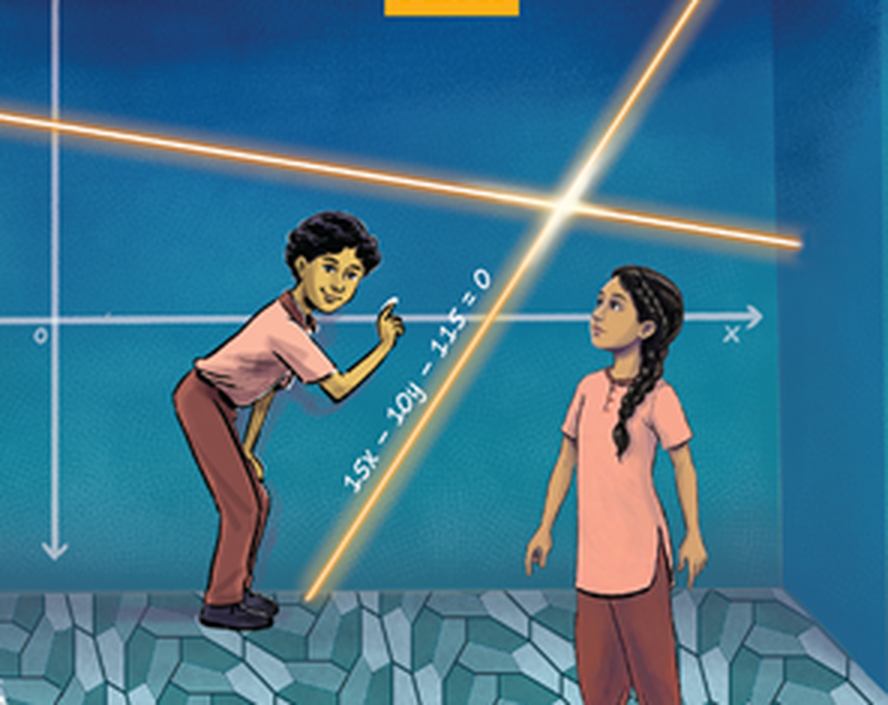
Chapter 13 End-of-Chapter Exercises Question 4 Solution : Find the point of intersection of the lines shown on the cover page.

Answer: needs the second line's equation

Note: the cover shows only one equation. The picture below is the book's cover.

What the cover gives
The cover of Ganita Manjari Part II. A boy writes the equation 15x minus 10y minus 115 equals 0 on a board with axes, and two glowing lines cross above his head.
Q4 · the cover of the book (from the book)

One line is labelled 15x − 10y − 115 = 0. Dividing by 5 gives 3x − 2y = 23, that is, y = 32x − 232. It has slope 32, crosses the x-axis at (233, 0) and the y-axis at (0, −11.5). On the cover this is the steep line that goes up to the right.

What is missing

The second line (nearly horizontal and going slightly down to the right) carries no equation, and the picture has no scale on its axes, so its equation cannot be read exactly from the cover. I have therefore not invented a number for the intersection point.

How to find it once the second equation is known
  1. Write the second line as a₂x + b₂y + c₂ = 0.
  2. Solve it together with 15x − 10y − 115 = 0 by elimination or substitution (they intersect if 15a₂ ≠ −10b₂).
  3. Check the point in both equations.

From the picture, the crossing point is above the x-axis, so on the line 3x − 2y = 23 it has y > 0 and therefore x > 233 ≈ 7.7.

The cover gives only 15x − 10y − 115 = 0; the intersection needs the second line's equation, then solve the pair by elimination. (Please send the second equation if you have it and I will complete this.)

Lines and slope

Chapter 13 End-of-Chapter Exercises Question 5 Solution : Give a formula for the x-intercept of the line y = mx + c.

Answer: x = −c/m
Put y = 0
0 = mx + c, so mx = −c, so x = −cm (m ≠ 0)

The x-intercept is the point (−cm, 0).

Special cases
  • If m = 0 and c ≠ 0, the line is horizontal and never meets the x-axis: there is no x-intercept.
  • If m = 0 and c = 0, the line is the x-axis itself.

The x-intercept of y = mx + c is −cm, provided m ≠ 0.

Pairs of equations

Chapter 13 End-of-Chapter Exercises Question 6 Solution : Plan A: ₹50 per month plus ₹0.20 per minute. Plan B: ₹30 per month plus ₹0.30 per minute. For how many minutes is Plan A cheaper? For how many is Plan B cheaper? When are they equal?

Answer: equal at 200 minutes
The costs
Plan A: 50 + 0.20t, Plan B: 30 + 0.30t
When they are equal
50 + 0.20t = 30 + 0.30t, so 20 = 0.10t, so t = 200

At 200 minutes both cost 50 + 40 = ₹90.

Which is cheaper
Cost of Plan A and Plan B against minutesThe two cost lines cross at 200 minutes, where both plans cost 90 rupees. Plan B is cheaper before that, Plan A after.Q6 · the plans cost the same at 200 minutes50100150200250300350400255075100125150minutes tcost (₹)Plan A: 50 + 0.20tPlan B: 30 + 0.30t(200, 90)
Q6 · the plans cross at (200, 90)
Minutes tCheaper planReason
less than 200Plan BB has the lower monthly fee, and the extra ₹0.10 per minute has not yet caught up
exactly 200equalboth ₹90
more than 200Plan AA's lower rate per minute wins

Check t = 100: A costs 70, B costs 60 (B cheaper). t = 300: A costs 110, B costs 120 (A cheaper).

Plan B is cheaper for fewer than 200 minutes, Plan A for more than 200 minutes, and they cost the same (₹90) at 200 minutes.

Lines and slope

Chapter 13 End-of-Chapter Exercises Question 7 Solution : How many lines (i) have a given slope? (ii) have a given slope and pass through a given point?

Answer: infinitely many; exactly one
Part (i)

Lines of the same slope m are y = mx + d for any d. Every value of d gives a different line, and they are all parallel. So there are infinitely many lines.

Part (ii)

If the line must also pass through (x₁, y₁), then y₁ = mx₁ + d fixes d = y₁ − mx₁. So there is exactly one such line, y − y₁ = m(x − x₁).

(i) Infinitely many (all parallel). (ii) Exactly one.

Nature of solutions

Chapter 13 End-of-Chapter Exercises Question 8 Solution : For what values of p does 4x + py + 8 = 0 and 2x + 2y + 2 = 0 have a unique solution?

Answer: p ≠ 4
Use the ratio rule

A unique solution needs a₁a₂ ≠ b₁b₂.

42 ≠ p2, so 2 ≠ p2, so p ≠ 4
Check p = 4

Then the equations are 4x + 4y + 8 = 0 and 2x + 2y + 2 = 0, which gives 4x + 4y + 4 = 0 after doubling the second: parallel lines with no solution.

The pair has a unique solution for every p except 4.

Chapter 13 End-of-Chapter Exercises Question 9 Solution : Find a and b so that (a + b)x − 2by = 5a + 2b + 1 and 3x − y = 14 have infinitely many solutions.

Answer: a = 5, b = 1
Write in standard form
(a + b)x − 2by − (5a + 2b + 1) = 0, 3x − y − 14 = 0

Infinitely many solutions need a + b3 = −2b−1 = 5a + 2b + 114.

Solve the conditions
  • From a + b3 = 2b: a + b = 6b, so a = 5b.
  • From 2b = 5a + 2b + 114: 28b = 5a + 2b + 1, so 26b = 5a + 1.
  • Put a = 5b: 26b = 25b + 1, so b = 1 and a = 5.
Check

With a = 5, b = 1 the first equation is 6x − 2y = 28, which is twice 3x − y = 14. ✓

a = 5 and b = 1.

Chapter 13 End-of-Chapter Exercises Question 10 Solution : Find k for which x + 2y = 3 and (k − 1)x + (k + 1)y = k + 3 are coincident lines.

Answer: k = 3
Equal ratios
1k − 1 = 2k + 1 = 3k + 3

From the first two: k + 1 = 2(k − 1), so k + 1 = 2k − 2, so k = 3.

Check with the third ratio: 3k + 3 = 36 = 12, and 1k − 1 = 12 ✓.

Check

For k = 3 the second equation is 2x + 4y = 6, which is 2 times x + 2y = 3. ✓

k = 3.

Pairs of equations

Chapter 13 End-of-Chapter Exercises Question 11 Solution : (i) Robot 1 starts at the origin and repeatedly moves 3 units right and 4 units up. Robot 2 starts at (10, 0) and repeatedly moves 1 unit right and 2 units up. Do the paths meet? (ii) Robot 1 starts at (3, 0) and repeatedly moves 5 right and 5 up. Robot 2 starts at (7, 0) and repeatedly moves 5 right and 3 down. Do the paths meet?

Answer: (i) meet at (30, 40); (ii) do not meet

How we read the paths: each robot's path is the straight line through its stopping points.

Part (i) · Equations of the pathsThey meet
  • Robot 1: slope 43 through the origin: y = 43x.
  • Robot 2: slope 21 = 2 through (10, 0): y = 2(x − 10).
43x = 2x − 20, so 20 = 23x, so x = 30, y = 40

Robot 2 starts at x = 10 and the meeting point has x = 30, so both robots do reach it: Robot 1 after 10 moves (3 × 10, 4 × 10) and Robot 2 after 20 moves (10 + 20, 2 × 20). The paths meet at (30, 40).

(If you follow the exact zig-zag steps, the two paths also touch earlier, for example at (24, 28), a corner of both paths.)

Part (ii) · Equations of the pathsThey do not meet
  • Robot 1: slope 1 through (3, 0): y = x − 3.
  • Robot 2: slope −35 through (7, 0): y = −35(x − 7).
x − 3 = −35x + 215, so 85x = 365, so x = 4.5, y = 1.5

The lines meet at (4.5, 1.5). But Robot 2 starts at x = 7 and only moves to the right, so it is never at x = 4.5. For x ≥ 7, Robot 1 has y ≥ 4 while Robot 2 has y ≤ 0. So the paths do not meet.

(In the exact zig-zag version they briefly share the ground between (7, 0) and (8, 0), but they never cross.)

(i) The paths meet at (30, 40). (ii) The lines would meet at (4.5, 1.5), but Robot 2 never goes there, so the paths do not meet.

Word problems

Chapter 13 End-of-Chapter Exercises Question 12 Solution : Jacob's watch reads a minutes after two o'clock. Fifteen minutes later it reads b minutes after three o'clock. a is six times b. What time was it the second time?

StarredAnswer: 3:09
Equations

The first time is 2 h and a minutes. The second time is 3 h and b minutes. The gap is 15 minutes, which is 60 + b − a.

60 + b − a = 15, so a = b + 45, and a = 6b

So 6b = b + 45, so b = 9 and a = 54.

Check

The first time is 2:54, and 15 minutes later it is 3:09. And 54 = 6 × 9 ✓.

The second time was 3:09 (9 minutes past three).

Chapter 13 End-of-Chapter Exercises Question 13 Solution : The sum of the digits of a two-digit number is 15. The number obtained by interchanging the digits exceeds the original by 9. Find the number.

StarredAnswer: 78
Equations

Let the tens digit be x and the units digit y.

x + y = 15, (10y + x) − (10x + y) = 9

The second gives 9y − 9x = 9, so y − x = 1. Adding to x + y = 15: 2y = 16, so y = 8 and x = 7.

Check

The number is 78, and reversed it is 87, which is 9 more. 7 + 8 = 15 ✓.

The number is 78.

Chapter 13 End-of-Chapter Exercises Question 14 Solution : In a cyclic quadrilateral ABCD, ∠A = (x + 7)°, ∠B = (y + 8)°, ∠C = (3y + 23)° and ∠D = (4x + 12)°. Find all four angles.

StarredAnswer: 37°, 48°, 143°, 132°
Opposite angles of a cyclic quadrilateral add up to 180°
∠A + ∠C = 180°: (x + 7) + (3y + 23) = 180, so x + 3y = 150
∠B + ∠D = 180°: (y + 8) + (4x + 12) = 180, so 4x + y = 160

From the second, y = 160 − 4x. Put in the first: x + 480 − 12x = 150, so 11x = 330, so x = 30 and y = 40.

The angles
AngleExpressionValue
∠Ax + 737°
∠By + 848°
∠C3y + 23143°
∠D4x + 12132°

Check: 37 + 143 = 180 ✓, 48 + 132 = 180 ✓ and the total is 360° ✓.

∠A = 37°, ∠B = 48°, ∠C = 143°, ∠D = 132°.

Chapter 13 End-of-Chapter Exercises Question 15 Solution : A train at uniform speed takes 6 hours less if its speed is 6 km/h more, and 6 hours more if its speed is 4 km/h less. Find the distance and the speed.

StarredAnswer: 720 km at 24 km/h
Equations

Let the speed be v km/h and the time t hours, so the distance is vt.

  • Faster by 6, time 6 less: (v + 6)(t − 6) = vt, which gives −6v + 6t − 36 = 0, so t − v = 6.
  • Slower by 4, time 6 more: (v − 4)(t + 6) = vt, which gives 6v − 4t − 24 = 0, so 3v − 2t = 12.

Put t = v + 6 into 3v − 2t = 12: 3v − 2v − 12 = 12, so v = 24 and t = 30.

Distance and check
distance = 24 × 30 = 720 km

Check: (24 + 6)(30 − 6) = 30 × 24 = 720 ✓ and (24 − 4)(30 + 6) = 20 × 36 = 720 ✓.

The speed is 24 km/h and the distance is 720 km.

Chapter 13 End-of-Chapter Exercises Question 16 Solution : A father's age equals the sum of the ages of his four children. After 20 years, the sum of the children's ages will be twice the father's age. Find the father's age.

StarredAnswer: 40 years
Equations

Let the father's age be F and the sum of the children's ages be S.

F = S

After 20 years each of the 4 children is 20 years older, so their sum is S + 80, and the father is F + 20.

S + 80 = 2(F + 20)
Solve

Replace S by F: F + 80 = 2F + 40, so F = 40.

Check

The children's ages add up to 40. In 20 years: 40 + 80 = 120 and the father is 60, and 120 = 2 × 60 ✓.

The father is 40 years old.

Answers at a glance

Question 4 needs an equation that is not visible on the cover; it is marked.

QuestionWhat is askedKey ideaAnswer
Q1 y = 3x and the tankSlope and intercept3; 0; 15 cm; 7 min; no; (3, 9)
Q2 Celsius and FahrenheitF = 9C/5 + 3286°F; 35°C; 32°F, −160/9 °C; −40°
Q3 2x + y = 6 and 2x − y − 2 = 0Graph(2, 2)
Q4 Cover-page intersectionNeeds both equationsOnly one equation is shown
Q5 x-intercept of y = mx + cPut y = 0−c/m
Q6 Mobile plans50 + 0.2t = 30 + 0.3t200 minutes
Q7 Lines with a given sloped is freeInfinitely many; exactly one
Q8 Unique solutiona₁/a₂ ≠ b₁/b₂p ≠ 4
Q9 Infinitely many solutionsEqual ratiosa = 5, b = 1
Q10 Coincident linesEqual ratiosk = 3
Q11 Two robotsLines and starting points(i) (30, 40); (ii) do not meet
Q12 Jacob's watch60 + b − a = 153:09
Q13 Two-digit numberx + y = 15, y − x = 178
Q14 Cyclic quadrilateralOpposite angles add to 180°37°, 48°, 143°, 132°
Q15 Traint − v = 6, 3v − 2t = 12720 km at 24 km/h
Q16 Father's ageF = S; S + 80 = 2(F + 20)40

Source of the questions: NCERT, Ganita Manjari, Grade 9, Part II, Chapter 13, End-of-Chapter Exercises. The solutions, explanations and diagrams on this page are our own working.

Call WhatsApp Book Demo