IGKO is TODAY!
Mock Test ₹150 View Schedule

Ganita Manjari · Class 9 · Part II · Chapter 14

Ganita Manjari Class 9 Maths Chapter 14 Math of Space: Surface Area and Volume End-of-Chapter Exercises Solutions

All 22 end-of-chapter questions: guesstimates, cubes, cones, spheres, the string around the Earth, a crow and marbles, and projects. Estimates are marked.

Last updated 6 October 2026

  • 22Questions
  • 1Diagrams
  • Ch 14Math of Space: Surface Area and Volume

How to answer every question

  1. Make a guess Write a quick guess before you calculate.
  2. Model the situation Pick a shape for the object and say your assumptions.
  3. Calculate Use the volume or surface-area formulas.
  4. Compare See how close your guess was, and say what changes the answer.

Guesstimate: a reasonable estimate when exact data are not given.

Assumption: a number or shape you choose, and state clearly.

Upper bound: a value the answer cannot exceed.

Guesstimates

Chapter 14 End-of-Chapter Exercises Question 1 Solution : Estimate how many scoops of ice cream can be obtained from a cuboidal container 10 cm × 15 cm × 20 cm. (Make a guess first.)

Guess ≈ 45 scoops

Note: this is a guesstimate. Your numbers may differ; the method matters.

Guess

The container is about the size of a small tub. A scoop is a ball a little bigger than a golf ball. A guess: about 40 to 50 scoops.

Model
container = 10 × 15 × 20 = 3000 cm³

Assume a scoop is a sphere of radius 2.5 cm (diameter 5 cm):

scoop = 43π(2.5)³ ≈ 65.4 cm³
number ≈ 300065.4 ≈ 46
Adjust

Scoops are not perfect spheres and ice cream is a little compressed, so real numbers are about 40 to 50. Our guess of 45 is close.

About 45 scoops (a sensible range is 40 to 50).
Cubes

Chapter 14 End-of-Chapter Exercises Question 2 Solution : A cube of integer side a is made of unit cubes. Write an expression for the number of unit cubes to be added to make a cube of side a + 1.

Answer: 3a² + 3a + 1
Difference of volumes
(a + 1)³ − a³ = a³ + 3a² + 3a + 1 − a³ = 3a² + 3a + 1
Why this makes sense

We add 3 faces of size a × a (3a² cubes), then 3 edges of a cubes each (3a), and the corner cube (1).

Check a = 1: 3 + 3 + 1 = 7, and 2³ − 1³ = 7 ✓. Check a = 2: 12 + 6 + 1 = 19 and 27 − 8 = 19 ✓.

3a² + 3a + 1 unit cubes.

Guesstimates

Chapter 14 End-of-Chapter Exercises Question 3 Solution : (i) Could a person drink enough water in a lifetime to fill a classroom? (ii) Estimate the number of bricks in the walls of your classroom.

StarredEstimates: no; about 15,000 bricks

Note: a guesstimate. The numbers below use an assumed classroom of 9 m × 9 m × 4.5 m. Use your own classroom's size.

Part (i) · Water in a lifetimeNo
  • Drinking about 2.5 litres a day for 75 years: 2.5 × 365 × 75 ≈ 68,000 litres = 68 m³.
  • The classroom: 9 × 9 × 4.5 = 364.5 m³ (about 13,000 cubic feet).
68364.5 ≈ 0.19

A lifetime of drinking fills only about one fifth of a classroom.

Part (ii) · Bricks
  • Walls: perimeter 36 m × height 4.5 m = 162 m². Take away about 10% for doors and windows: 146 m².
  • Wall thickness 20 cm = 0.2 m, so wall volume ≈ 146 × 0.2 ≈ 29 m³.
  • One brick with its mortar: 20 cm × 10 cm × 10 cm = 0.002 m³.
number of bricks ≈ 290.002 ≈ 14,500

So about 15,000 bricks.

(i) No, a lifetime of water is only about one fifth of a classroom. (ii) About 15,000 bricks for the assumed room.

Cubes

Chapter 14 End-of-Chapter Exercises Question 4 Solution : (A) one chocolate cube of side 50 mm, or (B) 100 chocolate cubes of side 10 mm. Which gives more chocolate?

Answer: option A
Compare volumes
OptionVolume
A50³ = 125,000 mm³
B100 × 10³ = 100 × 1000 = 100,000 mm³

A is 25,000 mm³ more. The big cube has 125 cubes of 10 mm in it (since 5 × 5 × 5 = 125), so B has only 100 of those 125.

Option A gives more chocolate (125,000 against 100,000 mm³).

Guesstimates

Chapter 14 End-of-Chapter Exercises Question 5 Solution : If all the people in the world are crowded in one place, how much area would they cover?

About 2000 km²

Note: a guesstimate with assumptions: 8 billion people, each person standing in 0.5 m × 0.5 m.

Model
area = 8 × 10⁹ × 0.25 m² = 2 × 10⁹ m² = 2000 km²

1 km² = 1,000,000 m², so 2 × 10⁹ m² is 2000 km². That is a square of side about 45 km, which is small compared with a large city or a small state.

About 2000 km² (a square about 45 km wide).

Cylinders

Chapter 14 End-of-Chapter Exercises Question 6 Solution : Each glass has diameter 7 cm and is filled to a height of 12 cm. How many litres of milk are needed for 1600 students? (1000 cm³ = 1 litre)

Answer: 739.2 litres
One glass
r = 3.5 cm, V = πr²h = 227 × 3.5 × 3.5 × 12 = 462 cm³
1600 glasses
1600 × 462 = 739,200 cm³ = 739,2001000 = 739.2 litres

739.2 litres of milk are needed.

Cones

Chapter 14 End-of-Chapter Exercises Question 7 Solution : The surface area of a sphere of radius 5 cm is five times the curved surface area of a cone of radius 4 cm. Find the height and the volume of the cone.

Answer: h = 3 cm; V = 16π ≈ 50.27 cm³
Slant height
4π × 25 = 5 × π × 4 × l ⟹ 100π = 20πl ⟹ l = 5 cm
Height and volume
h = √(l² − r²) = √(25 − 16) = 3 cm
V = 13π × 16 × 3 = 16π ≈ 50.27 cm³

Height 3 cm and volume 16π ≈ 50.27 cm³.

Spheres

Chapter 14 End-of-Chapter Exercises Question 8 Solution : Earth has radius 6370 km, Jupiter 69,900 km and the Sun 695,700 km. Find approximately the ratio of (i) the volume of Jupiter to Earth, (ii) the volume of the Sun to Earth.

Answer: about 1321 and 1.3 million times
Volume is proportional to the cube of the radius
(i) (69,9006370)³ ≈ (10.97)³ ≈ 1321
(ii) (695,7006370)³ ≈ (109.2)³ ≈ 1,302,700

So about 1300 Earths would fit in Jupiter and about 1.3 million Earths in the Sun.

(i) About 1321. (ii) About 1.3 × 10⁶ (1,302,700).

Chapter 14 End-of-Chapter Exercises Question 9 Solution : Show that the volume of a sphere is 23 of the volume of the smallest cylinder that encloses it.

Answer: 2 : 3
The cylinder

A sphere of radius r fits in a cylinder of radius r and height 2r.

Compare
sphere = 43πr³, cylinder = πr² × 2r = 2πr³
⁴⁄₃πr³2πr³ = 43 × 12 = 23

The sphere's volume is 23 of the cylinder's volume.

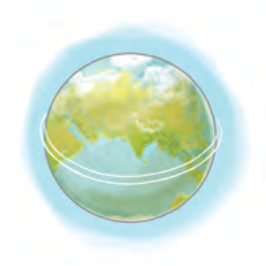
Chapter 14 End-of-Chapter Exercises Question 10 Solution : A string is wrapped tightly around the equator of the Earth. A second string 1 metre longer forms a larger circle at the same height above the ground everywhere. How high above the ground is it? Repeat for the Moon, Jupiter and a volleyball.

StarredAnswer: about 16 cm for every sphere
The picture
The Earth with a string wrapped around its equator and a slightly larger loop around it.
Q10 · two strings around the Earth (from the book)
The calculation

If the first circle has radius R, its length is 2πR. The second has radius R + d and length 2π(R + d). It is 1 m longer:

2π(R + d) − 2πR = 1 ⟹ 2πd = 1 ⟹ d = 12π ≈ 0.159 m ≈ 16 cm

R cancelled out, so d does not depend on the size of the sphere.

The four answers
ObjectRadiusHeight of second string
Earth6370 kmabout 16 cm
Moon1737 kmabout 16 cm
Jupiter69,900 kmabout 16 cm
Volleyballabout 10.5 cmabout 16 cm

It is surprising that the answers are all the same, and that the Earth needs only 1 m of extra string to lift the string 16 cm all around. The reason is that a circle's length grows in direct proportion to its radius (circumference = 2πr), so adding 1 m to the length adds the same 1 over 2π to the radius for every circle.

Always 12π ≈ 16 cm, for the Earth, the Moon, Jupiter and a volleyball.

Pyramids

Chapter 14 End-of-Chapter Exercises Question 11 Solution : A cylinder has base radius r and height h. A square pyramid fits inside with its base on the base of the cylinder, its corners on the boundary, and its apex on the top. Find the ratio of the volume of the pyramid to the volume of the cylinder.

StarredAnswer: 2 over 3π
The base
A square pyramid inside a cylinder, seen from aboveThe square base is inscribed in the circle of radius r. Its diagonal is 2r, so its side is r times root 2 and its area is 2 r squared.Q11 · the base square inscribed in the circle: diagonal = 2r, area = 2r²diagonal = 2rrtop viewpyramid volume = one third × 2r² × hvolume of cylinder = πr²hratio = 2 over 3π ≈ 0.212
Q11 · the base square inside the circle
Areas and volumes

The diagonal of the square is the diameter 2r. A square with diagonal d has area d²2, so the area is (2r)²2 = 2r². The height of the pyramid is h.

Vpyramid = 13 × 2r² × h = 2r²h3, Vcylinder = πr²h
VpyramidVcylinder = 2r²h3 × πr²h = 23π ≈ 0.212

The ratio is 23π (about 0.212).

Changes

Chapter 14 End-of-Chapter Exercises Question 12 Solution : What is the change in volume when (i) the length of a cuboid l × w × h is increased by 1 unit, (ii) the radius of a cylinder is increased by 1 unit, (iii)* the radius of a sphere is decreased by 1 unit?

StarredAnswer: (i) wh, (ii) 2πrh + πh, (iii) 4πr² − 4πr + 4π/3
Part (i)(c) wh cubic units
(l + 1)wh − lwh = wh
Part (ii)(e) 2πrh + πh cubic units
π(r + 1)²h − πr²h = πh(2r + 1) = 2πrh + πh
Part (iii)*
43πr³ − 43π(r − 1)³ = 43π(3r² − 3r + 1) = 4πr² − 4πr + 4π3

The volume decreases by 4πr² − 4πr + 4π3 cubic units. Check with r = 1: the sphere disappears, and the change is 4π − 4π + 4π3 = 4π3, which is the full volume ✓.

(i) (c) wh; (ii) (e) 2πrh + πh; (iii) a decrease of 4πr² − 4πr + 4π3.

Cubes

Chapter 14 End-of-Chapter Exercises Question 13 Solution : Given a cube of volume V, express its total surface area S in terms of V.

StarredAnswer: S = 6V2/3
Side from volume
a³ = V ⟹ a = V1/3
S = 6a² = 6V2/3
Check

V = 8 gives a = 2 and S = 24, and 6 × 82/3 = 6 × 4 = 24 ✓.

S = 6V2/3.

Chapter 14 End-of-Chapter Exercises Question 14 Solution : Given a cube of total surface area S, express its volume V in terms of S.

StarredAnswer: V = (S over 6) to the power 3 over 2
Side from surface area
6a² = S ⟹ a = √(S6)
V = a³ = (S6)3/2
Check

S = 24 gives a = 2 and V = 8, and (246)3/2 = 43/2 = 8 ✓.

V = (S6)3/2.

Spheres

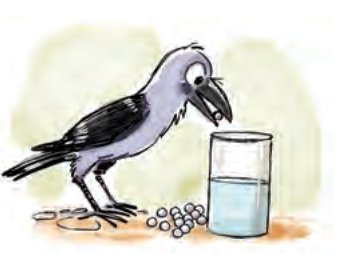
Chapter 14 End-of-Chapter Exercises Question 15 Solution : A glass of height 25 cm and radius 4 cm has water up to 16 cm. The crow needs the water at 20 cm. How many marbles of radius 1 cm should it drop in?

Answer: 48 marbles
The picture
A crow next to a glass of water with some marbles on the ground.
Q15 · the crow and the glass (from the book)
Volume to be displaced

The water must rise by 20 − 16 = 4 cm. The volume of that extra layer is:

π × 4² × 4 = 64π cm³
One marble and the count
one marble = 43π × 1³ = 4π3
number = 64π4π/3 = 64 × 34 = 48
Check

The glass is 25 cm tall and the water ends at 20 cm, so it does not overflow ✓.

The crow should drop 48 marbles.

Projects

Chapter 14 End-of-Chapter Exercises Question 16 Solution : Find the volume of ink in a new ball point pen. Take the necessary measurements and make approximations.

Estimate ≈ 0.08 cm³

Note: this is a hands-on project, so the numbers below are only a sample. Use your own pen.

Method
  1. Open the pen and take out the refill (the thin tube of ink).
  2. Measure the length of the ink column with a ruler: for example 10 cm.
  3. Measure the inner diameter of the tube: for example 1 mm, so the radius is 0.5 mm = 0.05 cm.
  4. The ink is a cylinder: V = πr²h.
V ≈ 3.14 × 0.05² × 10 ≈ 0.08 cm³

So a new pen holds about 0.08 cm³ (0.08 mL) of ink, which is less than a quarter of a teaspoon.

A sample answer: about 0.08 cm³. Your measurements may differ; the method (ink tube as a cylinder) is the point.

Chapter 14 End-of-Chapter Exercises Question 17 Solution : (i) A ball of chapati dough of radius 6 cm is made. Estimate how many chapatis can be made from it. (ii)* Cut a coconut or muskmelon in half and estimate the volume of edible flesh.

StarredEstimate ≈ 30 chapatis

Note: a guesstimate and a project, so the numbers below are sample assumptions.

Part (i) · Dough
dough = 43π × 6³ = 288π ≈ 905 cm³

Assume a chapati is a thin cylinder of radius 8 cm and thickness 1.5 mm = 0.15 cm:

one chapati = π × 8² × 0.15 ≈ 30.2 cm³
number ≈ 90530.2 ≈ 30
Part (ii) · Coconut (method)
  • Treat the outer shell as a hemisphere of outer radius R, and the empty hollow as a hemisphere of inner radius r.
  • Measure R across the cut face (for example 6 cm) and r across the hollow (for example 4.5 cm).
  • Flesh ≈ 23π(R³ − r³) = 23 × 3.14 × (216 − 91.1) ≈ 261 cm³ for one half.

(i) About 30 chapatis. (ii) Sample: about 260 cm³ of flesh per half, using 23π(R³ − r³).

Guesstimates

Chapter 14 End-of-Chapter Exercises Question 18 Solution : (i) If all the pages of this textbook were laid side by side on the floor, would they cover the classroom floor? (ii) What is the maximum number of textbooks that fit in a storeroom 15 ft × 20 ft × 30 ft?

About 6.5 m²; about 6 lakh books

Note: estimates with assumed sizes: a page is 17 cm × 24 cm, the book has about 160 pages, its thickness is 1 cm and 1 ft ≈ 30.5 cm.

Part (i) · Pages on the floorNo
one page = 17 × 24 = 408 cm², 160 pages = 65,280 cm² ≈ 6.5 m²

A classroom of 9 m × 9 m has 81 m². The pages cover only about 8% of the floor: no.

Part (ii) · Books in the storeroom
storeroom = 15 × 20 × 30 = 9000 ft³ ≈ 9000 × 28,317 ≈ 2.55 × 10⁸ cm³
one book = 17 × 24 × 1 = 408 cm³
number ≈ 2.55 × 10⁸408 ≈ 6.2 × 10⁵

Books are cuboids, so they can be stacked with almost no gaps. Rounding down for the edges of the room, the number is about 6 lakh books.

(i) No: about 6.5 m² of pages against about 81 m² of floor. (ii) About 6 lakh textbooks.

Chapter 14 End-of-Chapter Exercises Question 19 Solution : If the entire human population climbed into one giant cube, how long would its side be?

StarredAbout 800 m to 1.5 km

Note: a guesstimate with assumptions: 8 billion people.

Packed like water

A person's volume is about 0.07 m³ (a 70 kg person has a volume of about 70 litres). The total is 8 × 10⁹ × 0.07 = 5.6 × 10⁸ m³.

side = ∛(5.6 × 10⁸) ≈ 824 m
Standing with some room

If each person has 0.5 m × 0.5 m × 1.7 m = 0.425 m³ of space, the total is 3.4 × 10⁹ m³ and the side is ∛(3.4 × 10⁹) ≈ 1500 m.

Between about 820 m (tightly packed) and 1.5 km (standing room), depending on the assumption.

Spheres

Chapter 14 End-of-Chapter Exercises Question 20 Solution : The Earth has about 1.38 billion km³ of water. If it formed a uniform layer over the whole Earth, what would its thickness be? The Earth's radius is about 6371 km. (i) Write an expression. (ii) Simplify with a calculator.

StarredAnswer: about 2.7 km
Part (i) · Expression

The layer is the space between the sphere of radius R = 6371 and the sphere of radius R + t.

43π[(R + t)³ − R³] = V ⟹ t = ∛(R³ + 3V4π) − R
Part (ii) · Number
R³ = 2.586 × 10¹¹, 3V4π = 3 × 1.38 × 10⁹4π = 3.294 × 10⁸
t = ∛(2.586 × 10¹¹ + 3.294 × 10⁸) − 6371 ≈ 2.70 km

A quick check: the layer is thin, so t ≈ V4πR² = 1.38 × 10⁹4π × 6371² ≈ 2.71 km ✓.

(i) t = ∛(R³ + 3V4π) − R. (ii) About 2.7 km.

Changes

Chapter 14 End-of-Chapter Exercises Question 21 Solution : Give the dimensions of a cuboid whose volume is halved when its surface area is doubled.

StarredExample: 9×10×12 to 1×6×90

Note: the wording is open, so we read it as: find a cuboid and a re-shaped cuboid with half the volume and double the surface area. (A simple scaling of the same shape cannot do both.)

An example
DimensionsVolumeSurface area
Original9 × 10 × 1210802(90 + 108 + 120) = 636
Re-shaped1 × 6 × 905402(6 + 90 + 540) = 1272

The volume is half of 1080 and the surface area is twice 636 ✓.

How such an example is found

Choose a cuboid with volume V and surface area S. Then look for whole-number edges a, b, c with abc = V2 and 2(ab + ac + bc) = 2S. A long thin shape has a large surface area for its volume, so making one edge 1 often works.

Check the example

Edges 1, 6, 90 give 6 × 90 = 540 cm³ = 10802 ✓ and 2(6 + 90 + 540) = 1272 = 2 × 636 ✓.

9 × 10 × 12 turned into 1 × 6 × 90 halves the volume and doubles the surface area. (Others: 8 × 12 × 15 to 1 × 12 × 60.)

Projects

Chapter 14 End-of-Chapter Exercises Question 22 Solution : Find the volume of your house, making necessary approximations, and present how you solved it.

Method with a sample

Note: a project, so the numbers below are only a sample.

Method
  1. Draw a simple plan of your house: list the rooms as cuboids.
  2. Measure each room's length, width and height (a tape or your paces: one pace is about 0.75 m).
  3. Calculate the volume of each room: V = l × w × h.
  4. Add the room volumes, and add something for walls and floors if you want the volume of the whole house.
  5. State your assumptions: ignore furniture, treat slanted ceilings as flat at the average height.
A sample
Rooml × w × h (m)Volume (m³)
Living room5 × 4 × 360
Bedroom 14 × 3.5 × 342
Bedroom 23.5 × 3 × 331.5
Kitchen3 × 3 × 327
Bathroom2 × 2 × 312
Total172.5

The house holds about 170 m³ of air, which is about 1,70,000 litres.

Add the volumes of the rooms: the sample house is about 172.5 m³. Your own house will give your own answer.

Answers at a glance

Guesstimates and projects use stated assumptions, so your numbers may differ.

QuestionWhat is askedKey ideaAnswer
Q1 Ice cream scoops3000 over 65.4≈ 45
Q2 Add a layer to a cube(a + 1)³ − a³3a² + 3a + 1
Q3 Water and bricksAssumed classroomNo; ≈ 15,000 bricks
Q4 Chocolate options125,000 against 100,000A
Q5 Area for all people8 billion × 0.25 m²≈ 2000 km²
Q6 Milk for 1600462 cm³ each739.2 L
Q7 Cone and spherel = 5h = 3; V = 16π
Q8 Jupiter and SunRadius cubed1321; 1.3 million
Q9 Sphere in cylinder2πr³ over 4πr³/32 : 3
Q10 String around a sphered = 1 over 2π≈ 16 cm
Q11 Pyramid in cylinderBase area 2r²2 over 3π
Q12 Changes in volumeExpandwh; 2πrh + πh; decrease 4πr² − 4πr + 4π/3
Q13 S from Va = V1/36V2/3
Q14 V from Sa = √(S/6)(S/6)3/2
Q15 Crow and marbles64π over 4π/348
Q16 Ink in a penπr²h≈ 0.08 cm³ (sample)
Q17 Dough and coconutSphere over thin cylinder≈ 30 chapatis
Q18 Book pages and storeroomAreas and volumesNo; ≈ 6 lakh
Q19 Giant cube of peopleVolume of a person≈ 0.8 to 1.5 km
Q20 Water layerShell volume≈ 2.7 km
Q21 Half volume, double areaSearch for integers9×10×12 to 1×6×90
Q22 Volume of a houseAdd roomsMethod and sample

Source of the questions: NCERT, Ganita Manjari, Grade 9, Part II, Chapter 14, End-of-Chapter Exercises. The solutions, explanations and diagrams on this page are our own working.

Call WhatsApp Book Demo