The boxes fit exactly: 402 = 20 along the length, 251.25 = 20 along the width and 101 = 10 along the height, and 20 × 20 × 10 = 4000 ✓.
The godown holds 4000 boxes.
Q4
Chapter 14 Exercise 14.1 Question 4 Solution: Two cubes each of volume 125 cm³ are joined end to end. Find the surface area of the resulting cuboid.
Answer: 250 cm²
Side of each cube
ƒa³ = 125, so a = 5 cm
The cuboid
Joined end to end, the cuboid is 10 cm long, 5 cm wide and 5 cm high.
ƒSA = 2(lw + lh + wh) = 2(50 + 50 + 25) = 250 cm²
Check: the two cubes have 12 faces of 25 cm² = 300 cm². The two faces that were joined are hidden: 300 − 2 × 25 = 250 ✓.
The surface area is 250 cm².
Q5
Chapter 14 Exercise 14.1 Question 5 Solution: A cube of side 4 cm is cut into cubes of side 1 cm. What is the ratio of the surface area of the original cube to the total surface area of all the cut-out cubes?
Answer: 1 : 4
Surface areas
Solid
Number
Surface area of each
Total
Original cube (4 cm)
1
6 × 4² = 96 cm²
96 cm²
Small cubes (1 cm)
4³ = 64
6 × 1² = 6 cm²
64 × 6 = 384 cm²
Ratio
ƒ96384 = 14
The volume did not change, but the surface area became 4 times larger. Cutting into smaller pieces always exposes more surface. This is why a fine powder dissolves faster than a lump, and why small cells can absorb food quickly.
The ratio is 1 : 4.
Q6
Chapter 14 Exercise 14.1 Question 6 Solution: The areas of the three faces of a cuboid that meet at a corner are 6 cm², 15 cm² and 10 cm². Find the volume.
Answer: 30 cm³
Name the edges
Let the edges be l, w, h. The three face areas are lw = 6, wh = 15 and lh = 10.
The edges are l = 2, w = 3, h = 5: lw = 6 ✓, wh = 15 ✓, lh = 10 ✓, and 2 × 3 × 5 = 30 ✓.
The volume is 30 cm³.
Painted cube and integer cuboids
Q7
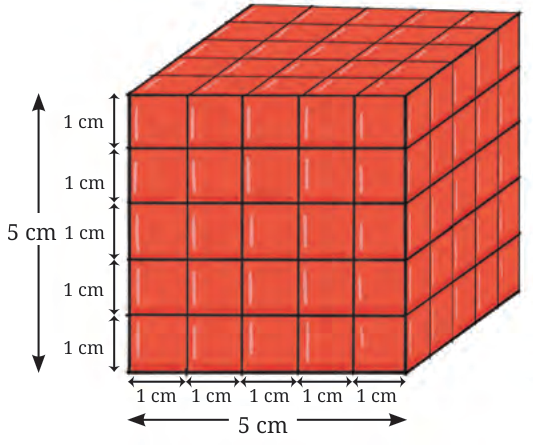
Chapter 14 Exercise 14.1 Question 7 Solution: A cube of side 5 cm is painted on all its faces and then sliced into 1 cm³ cubes. How many of these have (i) exactly three faces painted, (ii) exactly two, (iii) exactly one, (iv) none?
StarredAnswer: 8, 36, 54, 27
The cube
From the book
↔ Swipe sideways to see the whole chart
Q7 · the 5 cm cube cut into 125 small cubes (from the book)
Count by position
Diagram
↔ Swipe sideways to see the whole diagram
Q7 · painted faces layer by layer
Type of small cube
Where it is
How many
Painted faces
Corner
8 corners
8
3
Edge (not a corner)
12 edges, each has 5 − 2 = 3 of them
12 × 3 = 36
2
Face (not an edge)
6 faces, each has 3 × 3 = 9
6 × 9 = 54
1
Inside
a 3 × 3 × 3 block
27
0
Check the total
ƒ8 + 36 + 54 + 27 = 125 = 5³
(i) 8, (ii) 36, (iii) 54, (iv) 27.
Q8
Chapter 14 Exercise 14.1 Question 8 Solution: Find a cuboid with integer edges (cm) whose total surface area is exactly 100 cm². (i) Is there more than one? (ii) Can you find them all? (iii) Show that you have found them all.
StarredAnswer: 1×2×16 and 2×4×7
Set up
2(lw + lh + wh) = 100, so lw + lh + wh = 50. Take l ≤ w ≤ h.
For the smallest edge l, add l² to both sides and factorise:
ƒlw + lh + wh = 50 ⟹ (w + l)(h + l) = 50 + l²
Why l is small
Since l is the smallest, lw + lh + wh ≥ 3l², so 3l² ≤ 50, so l ≤ 4. Try l = 1, 2, 3, 4.
l
(w + l)(h + l) = 50 + l²
Factor pairs with w + l ≥ 2l
Cuboid
1
51 = 3 × 17
w + 1 = 3, h + 1 = 17
w = 2, h = 16: 1 × 2 × 16
2
54 = 6 × 9
w + 2 = 6, h + 2 = 9
w = 4, h = 7: 2 × 4 × 7
3
59 (prime)
none
none
4
66 = 6 × 11, 2 × 33, 3 × 22
need w + 4 ≥ 8: none
none
Answers
(i) Yes, there are two. (ii) and (iii) The table covers every l from 1 to 4, and l cannot be larger, so these are all.
Source of the questions: NCERT, Ganita Manjari, Grade 9, Part II, Chapter 14, Exercise Set 14.1. The solutions, explanations and diagrams on this page are our own working.